
Answering Questions Confidently | 28-day free English course

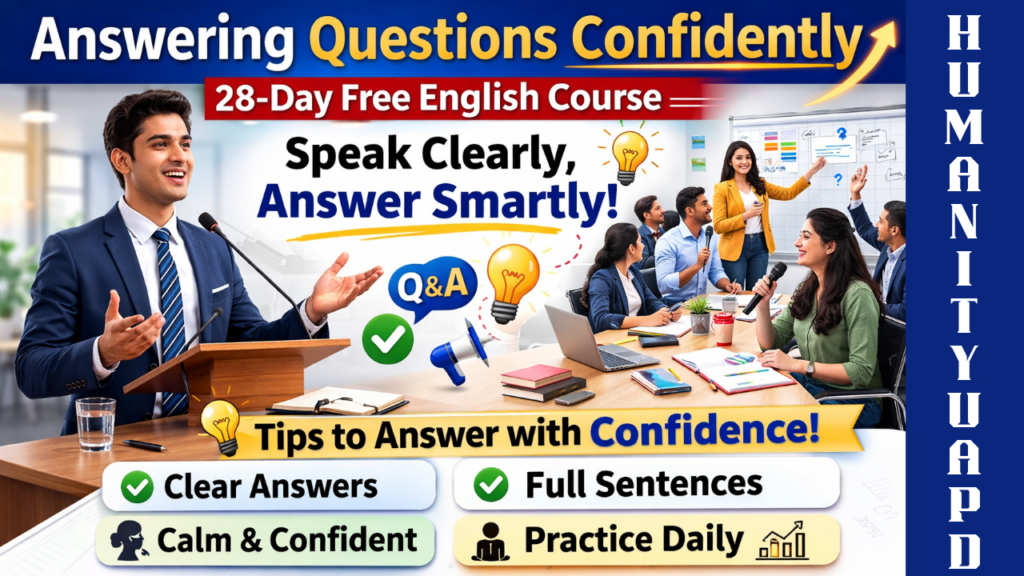
Answering Questions Confidently
Confidence plays a pivotal role when it comes to answering questions in English, as it directly impacts the effectiveness of communication. When learners approach a query with assurance, their ability to convey thoughts becomes significantly enhanced. This confidence not only allows speakers to articulate their ideas clearly but also fosters a positive impression on listeners, which is especially crucial in environments such as school, work, and daily interactions.
In an academic setting, for example, a student who answers questions with confidence is likely to engage their peers and instructors. This engagement can lead to a more dynamic exchange of ideas and encourages others to participate actively. A confident response demonstrates a command of the subject matter, instilling trust in the speaker’s knowledge. When classmates perceive a student as self-assured, they may be more inclined to seek their input, resulting in collaborative learning opportunities.
In the workplace, the importance of confidence becomes even more pronounced. Professionals who answer questions with certainty are often seen as leaders. This can influence team dynamics positively, fostering an environment where ideas are freely shared and innovation is encouraged. For instance, during meetings, employees who present their thoughts confidently are likely to gain respect from colleagues and superiors alike. This respect can translate into greater responsibilities and career advancement opportunities.
Moreover, in everyday life, everyday conversations benefit immensely from confident answering. Whether at a grocery store, a restaurant, or during informal gatherings, answering questions with poise can encourage interactions. This engagement helps cultivate relationships, making communication more pleasant and effective. Overall, the ability to answer questions with confidence not only enhances personal self-esteem but also significantly improves the quality of interactions in all aspects of life.
👉 Table of Contents 👇
Simple Structures for Short Answers
When engaging in conversations or classroom dialogues, the ability to provide concise and direct answers can significantly enhance communication. The simplest forms of responses often come down to two basic words: “Yes” and “No.” These words, though short, convey clear affirmation or denial, making them powerful tools in verbal exchanges.
For instance, if someone inquires, “Are you attending the meeting today?” a confident “Yes” asserts your participation, while a straightforward “No” communicates your absence. These responses can be supplemented by nodding or maintaining steady eye contact, which further reinforces the clarity of your answer. Such non-verbal cues are vital for conveying confidence and certainty.
Additionally, it is important to consider context. Short answers are particularly effective in situations where time is limited or when choices must be made quickly. For example, during classroom activities, students can utilize these brief responses when asked questions that require immediate feedback, such as “Do you understand the material?” Here, encouraging answers ranging from “Yes” to “No” inclusively promotes active participation without overwhelming learners.
To ensure your answers sound assertive, speak clearly and at a measured pace. Avoid trailing off at the end of your responses, which can imply uncertainty. Using a steady tone and maintaining an upright posture can also help project confidence. Practicing these responses in various scenarios, such as mock interviews or group discussions, can further refine your ability to communicate effectively.
In summary, employing simple sentence structures for short answers like “Yes” and “No” provides clarity in conversations and classroom interactions. By integrating confident delivery techniques, individuals can enhance their authority and engagement during discussions.
How to Give Full Sentence Answers
Providing full sentence answers is crucial for clarity in communication, particularly in professional and educational settings. A full sentence structure typically consists of a subject, a verb, and often an object, ensuring that the response is complete and informative. For instance, when asked, “Do you enjoy reading?” a simple reply is insufficient. A more comprehensive response would be, “Yes, I enjoy reading various genres, especially science fiction and historical novels.” This structure not only conveys the answer but also adds context that enriches the communication.
To effectively expand short answers into full sentences, one can follow a simple guideline: connect the answer directly to the question while providing additional detail. For example, instead of responding with a brief, “I finished the project,” one could elaborate by saying, “I completed the project ahead of the deadline, which allowed me to focus on refining the details further.” This transformation of a short reply into a fuller sentence serves multiple purposes: it demonstrates communication skills and helps in articulating one’s thoughts more coherently.
The benefits of answering questions in full sentences become particularly evident in formal settings. Speaking in complete sentences enhances the listener’s understanding and engagement. It shows that one is thoughtful about their response and respects the communicative exchange. Moreover, full sentence answers can also facilitate a more dynamic dialogue by leaving room for follow-up questions or deeper discussions. Clear articulation of ideas can effectively prevent misunderstandings, thereby fostering a more productive environment.
In summary, developing the habit of giving full sentence answers can lead to improved communication skills that are essential for success in various fields. By consistently practicing this approach, individuals can enhance their verbal clarity and confidence in any discourse.

How to Answer Wh-Questions
Wh-questions are a fundamental aspect of communication, essential for obtaining information in various contexts. The main types of Wh-questions include who, what, where, when, why, and how. Each type serves a different purpose and follows a specific structure when forming answers. Mastering the art of answering these questions can enhance your communication skills greatly.
1. Who: This question seeks to identify a person or people. For instance, if someone asks, “Who is your favorite author?” a structured answer could be, “My favorite author is J.K. Rowling.” In this case, you provide the name specifically related to the query.
2. What: This type of question seeks information about objects, ideas, or concepts. For example, if asked, “What do you do in your free time?” an effective response could be, “In my free time, I enjoy reading novels and hiking in nature.” Here, the focus is on providing direct information about activities.
3. Where: Questions beginning with ‘where’ aim to pinpoint locations. For example, if someone asks, “Where is your company located?” you might reply, “Our company is located downtown, on 5th Avenue.” The answer should be concise while giving the exact location information.
4. When: This question pertains to time. An example is, “When does the meeting start?” A good answer could be, “The meeting starts at 10 a.m. tomorrow.” This format clearly communicates the relevant time.
5. Why: Questions starting with ‘why’ seek explanations. For instance, if asked, “Why are you studying this subject?” an answer might be, “I am studying this subject to enhance my skills for future job opportunities.” Here, providing reasoning is vital.
6. How: This question asks about the manner of doing something. If someone says, “How do you plan your day?” a possible response could be, “I plan my day by creating a to-do list the night before.” This format emphasizes the process involved.
In daily conversations, Wh-questions appear frequently, such as when asking for directions or discussing plans with friends or colleagues. Employing these structured responses not only aids in clarity but also boosts confidence in your communication abilities. By practicing how to answer these types of questions, individuals can engage more effectively and provide the information desired in a clear, direct manner.
Examples of Confident vs Unclear Answers
In communication, the way answers are delivered can significantly impact the listener’s understanding and perception of the speaker. Confident responses typically convey clarity, conviction, and decisiveness, while unclear answers may create confusion and uncertainty. To illustrate this difference, consider the following examples.
Example 1: Imagine a job interview scenario. When asked, “What are your strengths?” a confident candidate might respond, “I excel in time management, allowing me to prioritize tasks effectively and meet deadlines consistently. For instance, in my previous role, I led a project that improved our team’s efficiency by 30% within six months.” Here, the speaker not only identifies a strength but backs it up with a specific example, provides context, and demonstrates an understanding of the importance of the trait.
In contrast, an unclear answer might sound like this: “Well, I think I can manage my time okay, but sometimes I have trouble with it. I guess it depends on the situation.” This response lacks confidence and specificity, leaving the interviewer questioning the candidate’s capabilities.
Example 2: Participating in a group discussion, consider the prompt, “How should we address the budget concerns?” A confident participant may assert, “To address the budget concerns effectively, I propose we conduct a detailed review of our expenditures and identify areas for potential savings. I can initiate this process by analyzing our last quarter’s spending patterns.” This response is not only assertive but also proactive, demonstrating readiness to tackle challenges.
On the other hand, an unclear response could be, “Maybe we should think about budget cuts, but I’m not sure where exactly.” This response communicates hesitation and ambiguity, undermining the individual’s authority in the conversation.
These examples highlight the necessity for individuals to practice identifying and delivering confident versus unclear answers in various conversational contexts. By engaging in this practice, learners can develop their communication skills and enhance their effectiveness in interactions.
Tips to Sound Calm and Natural
When faced with a question, maintaining a calm and natural demeanor is essential for effective communication. One effective technique is to take a deep breath before responding. This simple act not only helps to center your thoughts but also reduces anxiety, providing you a moment to collect your ideas before you articulate your response. Deep breathing encourages a relaxed state, which can greatly enhance your tone and delivery.
Maintaining eye contact with the person asking the question is another critical element of sounding calm. Eye contact establishes a connection and signifies your confidence and assurance in what you are saying. It reassures your audience that you are engaged and sincere, which can make your answers more impactful. However, it’s important to strike a balance; too much eye contact can feel aggressive, while too little can indicate disinterest.
Additionally, practicing a measured tone of voice is crucial in conveying calmness. Aim for a steady pace rather than rushing through your words. Speaking slowly allows your audience to absorb what you are saying and gives you time to think ahead. This can be particularly helpful when addressing complex questions that require thoughtful answers. Utilize vocal variation to emphasize key points without sounding monotonous or overly rehearsed.
Overcoming nervousness is often a challenge when responding to questions. One effective strategy involves visualizing a positive outcome before you engage in your response. Picture yourself answering confidently and successfully engaging your audience. Furthermore, rehearsing answers to common questions in advance can build your comfort level and enhance your natural speaking style. Through consistent practice, speaking with calmness and authenticity can become second nature, empowering you to handle inquiries with poise.
What to Do If You Don’t Understand the Question
In any learning environment, there may be instances where one does not fully grasp the question being asked. This situation can arise due to various factors such as language barriers, unfamiliar jargon, or simply the complexity of the inquiry. It is essential to recognize that it is perfectly acceptable to seek clarification. Acknowledging this can significantly enhance communication, ensuring that individuals engage more effectively in the discussion.
When faced with a question that appears ambiguous or unclear, the first step is to communicate your confusion in a respectful manner. Phrases such as “Could you please clarify what you mean by that?” or “I’m not quite sure I understand the question fully; could you explain it differently?” can convey your need for further explanation without undermining your confidence. These inquiries demonstrate a proactive approach to understanding and show a commitment to effective communication.
Moreover, it can be helpful to restate the question in your own words, allowing the other party to confirm your understanding or to provide additional details. For instance, you might say, “If I understand correctly, you are asking about… Is that right?” This technique not only reassures you about your understanding but also engages the questioner in a constructive dialogue.
Asking for help when needed is a strength, not a weakness. It reflects a willingness to learn and ensures that discussions are productive and informed. Embracing this mindset fosters a more collaborative atmosphere, thereby enhancing the overall learning experience. Remember, clarity is crucial in communication; hence, never hesitate to seek it out when required.

Small Speaking Practice
Building confidence in speaking skills can be fostered through practical application in everyday scenarios. One effective method is to create opportunities for learners to practice answering questions with family members or friends. This could involve setting aside a few minutes each day to engage in dialogue that emulates common conversational situations.
For instance, learners could simulate a casual coffee shop conversation where one person plays the role of a customer while the other acts as the barista. The customer can ask about the menu, inquire about recommendations, or express preferences. This exercise not only facilitates speaking practice but also encourages critical thinking as learners decide how to respond to varying questions.
In another scenario, consider a role-reversal exercise where learners take turns being a news reporter and an interviewee. The interviewer can ask questions regarding current events or personal interests, allowing participants to practice providing clear and concise answers in real-time. This activity can help learners adapt to spontaneous question formats, making them more adept at responding confidently under pressure.
To reinforce learning further, learners can incorporate themed practice sessions, such as “Weekend Plans,” where they discuss what they intend to do over the weekend. They can prepare by thinking about potential questions, such as “What activities do you plan to do?” or “Who will you spend time with?” This strategic approach not only enhances their ability to articulate thoughts but builds a habit of integrating these speaking opportunities into their daily routine.
By utilizing these engaging role-play activities, learners will feel more comfortable answering questions in various settings. Continuous practice in a supportive environment ensures that their speaking skills develop naturally, leading to greater confidence in their conversational abilities.
Encouragement and Practice Activity
To effectively answer questions with confidence, it is crucial to recognize that practice plays a fundamental role in developing this skill. Just as musicians rehearse their pieces and athletes train to enhance their performance, individuals can benefit immensely from regular practice when it comes to answering questions. It is essential to approach this process with a positive mindset, understanding that each attempt, successful or challenging, brings an opportunity for growth.
One effective strategy to bolster confidence in answering questions is to engage in role-playing activities. This can be done solo or with a partner. For individuals practicing alone, a simple exercise involves choosing a topic of interest and preparing responses to common questions related to that subject. This could range from professional topics to hobbies or current events. Once you have formulated your answers, practice stating them out loud to simulate a real-life scenario. This exercise not only enhances your verbal communication abilities but also helps to organize your thoughts under pressure.
If you prefer to collaborate with a partner, consider conducting a mock interview where one person poses questions, and the other practices responding. This interaction provides immediate feedback and an opportunity to refine answers based on the partner’s response and observations. Such interactive practice allows for adjustments to body language and tone, both of which are vital components of effective communication.
The key takeaway is to approach these practice sessions with an open attitude, as confidence grows with experience. Regularly practicing answering questions will not only prepare you for real-life inquiries but will also affirm your ability to communicate effectively. Embrace the journey of continuous improvement, and remember that every question you confidently answer contributes to your personal and professional growth.
FAQs – Answering Questions Confidently
Why is confidence important when answering questions in English?
Confidence helps you speak clearly and makes people trust your ideas. When you sound confident, listeners understand you better and respect your opinion in school, work, and daily life.
How can beginners answer questions confidently?
Beginners can:
– Use short but clear answers.
– Speak slowly and clearly.
– Add one small detail to their answer.
– Practice daily with simple questions.
Example:
❌ Yes.
✅ Yes, I understand the lesson.
Should I always answer in full sentences?
In formal situations (school, interviews, meetings), yes.
In casual conversations, short answers are okay.
Full sentences sound more professional and confident.
How do I answer Wh-questions correctly?
Follow this simple rule:
– Listen carefully.
– Start with the main answer.
– Add a small explanation.
Example:
Question: Why are you learning English?
Answer: I am learning English to improve my career opportunities.
What should I do if I don’t understand the question?
It’s completely okay to ask for clarification. You can say:
– Could you please repeat the question?
– I’m sorry, could you explain that again?
– Do you mean…?
Asking for clarification shows confidence and willingness to learn.
How can I sound calm when answering questions?
– Take a deep breath.
– Maintain eye contact.
– Speak at a natural pace.
– Pause for 1–2 seconds before answering.
How can I practice answering questions daily?
Try this:
– Practice with a friend or family member.
– Record yourself answering common questions.
– Answer 3–5 questions every day.
– Watch English interviews and repeat answers.
How long does it take to become confident?
Confidence grows with regular practice.
If you practice speaking 5–10 minutes daily, you can see improvement within a few weeks.

Share this:

