Articles | Day 10 | Easy English Course | English in 28 days

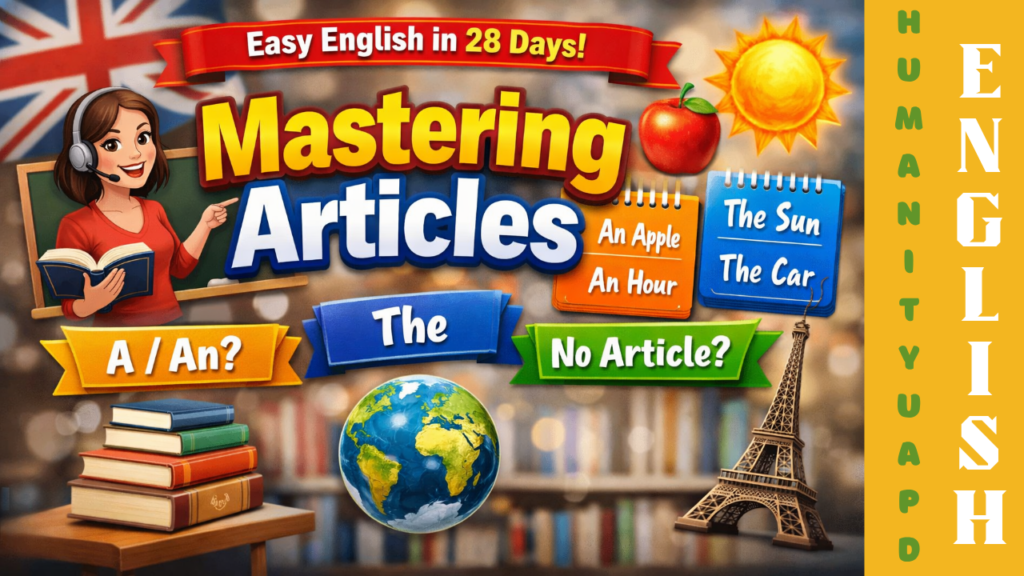
Articles
In the English language, articles are essential components that serve to clarify the specificity and definiteness of nouns. They function as determiners, providing crucial information about the nouns they precede. Essentially, there are two types of articles: definite articles and indefinite articles. Understanding how these articles operate within sentences is vital for grasping the nuances of English syntax.
The definite article, “the,” indicates a specific noun that is known to the reader or listener. For example, in the phrase “the book on the table,” the article specifies which book is being referred to, implying that it is a particular book familiar to both the speaker and the audience. This specificity is pivotal in ensuring clear communication.
On the other hand, indefinite articles, which include “a” and “an,” refer to non-specific nouns. They are used when the exact identity of the noun is not crucial or when it is being mentioned for the first time. For instance, saying “a dog barked” introduces the idea of any dog rather than a specific one. Such distinctions play a significant role in conveying meaning accurately.
The use of articles not only aids in avoiding ambiguity but also enriches the English language by allowing greater flexibility in expressing both general and specific ideas. Articles contribute to the syntactic structure of sentences, enabling speakers and writers to convey their thoughts with precision.
Overall, a solid understanding of articles and their proper usage is fundamental for anyone learning English. Mastering this aspect of grammar aids in effective communication, ensuring that messages are delivered clearly and succinctly.
👉 Table of Contents 👇
Types of Articles: Definite and Indefinite
In English, articles play a crucial role in the structure of sentences, providing clarity and context. The two main types of articles are definite and indefinite articles. The definite article is “the,” while the indefinite articles are “a” and “an.” Each serves a distinct purpose in communication.
The definite article, “the,” is used when referring to a specific noun that is already known to the reader or listener. For instance, in the sentence, “The cat sat on the mat,” the use of “the” indicates that both the speaker and the recipient are aware of which specific cat is being discussed. This article can be applied to singular or plural nouns, as seen in “the dogs barked” where a specific group of dogs is mentioned.
On the other hand, indefinite articles such as “a” and “an” are used to introduce a noun that is not specifically known to the reader or listener. For example, saying, “I saw a movie last night” suggests that any movie was watched, not one defined or known. The choice between “a” and “an” depends on the sound that follows; “a” precedes words that begin with a consonant sound (as in “a book”), while “an” precedes words that start with a vowel sound (as in “an apple”).
Furthermore, the context can dictate the choice of article. If one says, “I would like to be a teacher,” it implies a general desire to enter the profession. Conversely, specifying “I would like to be the teacher at school X” conveys a particular intent. Understanding and applying these types of articles correctly is essential for achieving precise communication in English.
When to Use ‘A’ vs. ‘An’
In English grammar, the choice between using ‘a’ or ‘an’ is determined primarily by the phonetic sound that follows the article, rather than the actual first letter of the following word. ‘A’ is used before words that begin with a consonant sound, while ‘an’ is used before words that start with a vowel sound. This distinction is crucial for maintaining the natural flow of speech.
For instance, one would say “a cat” since the word “cat” starts with a consonant sound. Conversely, in the phrase “an apple,” the word “apple” begins with a vowel sound, necessitating the use of ‘an’. This rule applies even in scenarios where a vowel may be represented by a consonant letter based on pronunciation. For example, we say “a university” because the ‘u’ in university sounds like ‘yoo,’ a consonant sound.
However, some words that start with a consonant letter may require ‘an’ due to their vowel sounds. Consider the word “hour”; since it begins with a silent ‘h’, it is appropriate to say “an hour”. Similarly, “an honor” is correct, reflecting the same phonetic principle. On the other end of the spectrum, words like “euros” are pronounced with a ‘y’ sound at the beginning, thus using ‘a’ would be correct, resulting in “a euro.”
This phonetic basis for selecting between ‘a’ and ‘an’ aids in the smoothness of verbal communication, preventing awkward pauses that could occur when the wrong article is used. Familiarity with these rules can significantly enhance one’s proficiency in English, making it easier to convey messages accurately and fluently.

The Role of ‘The’: Specificity and Context
The definite article ‘the’ serves a crucial function in the English language, signifying specificity and providing context to the nouns it precedes. Unlike indefinite articles such as ‘a’ and ‘an’, which refer to any member of a group, ‘the’ points to a particular item or concept that both the speaker and listener are familiar with. This shared understanding is central to effective communication.
For instance, when one says, “Please pass me the salt,” the use of ‘the’ signifies a specific container of salt that both individuals are aware of, contrasting with a statement like, “Please pass me a salt,” which would imply any container of salt. This illustrates how ‘the’ establishes a connection between the speaker and the listener, fostering clarity.
Context plays an integral role in determining when to use ‘the’. It can indicate structures, events, or ideologies assuming that the audience recognizes them. For example, saying “the sun is bright today” assumes recognition of which sun is being referenced—our solar system’s star—making the definite article indispensable.
In scenarios involving unique entities or groups, ‘the’ is frequently utilized. Phrases like “the President,” “the universe,” or “the internet” imply an acknowledged specificity known in common discourse. Moreover, ‘the’ can also be used with superlatives, such as “the best option,” highlighting not just specificity but also comparison and ranking.
Understanding the usage of ‘the’ is vital for learners of English, as it encapsulates how context shapes meaning, and how clarity is achieved through specificity. Hence, the effective use of ‘the’ hinges on a combination of situational awareness and a shared frame of reference between communicators.
Zero Article: When No Article is Used
The concept of the zero article refers to the absence of an article before a noun. This occurs in various cases in the English language, often adding clarity and precision to statements. Understanding the contexts in which the zero article is utilized is essential for mastering the use of articles.
One of the primary situations where the zero article is applied is with plural nouns. When referring to general categories or classes of things, plural nouns do not take an article. For instance, in the sentence “Dogs are friendly animals,” the term “dogs” refers to all dogs in general, thus a zero article is appropriate. This use of the zero article enables speakers and writers to convey generality without specifying individual members of the noun group.
Another significant instance of the zero article is observed with uncountable nouns. Uncountable nouns, which refer to substances, concepts, or abstract ideas that cannot be counted, typically do not require an article. For example, saying “Water is essential for life” is a correct application of the zero article. Here, “water” represents the substance in general rather than a specific quantity or instance, fitting seamlessly into the structure of the sentence without the introduction of an article.
Proper nouns also frequently adopt the zero article. These nouns, which name specific entities such as individuals, cities, and countries, stand alone without the need for an article. For example, in the phrase “Paris is a beautiful city,” the name “Paris” does not require an article because it denotes a specific location.
In summary, recognizing the instances where the zero article is appropriate—such as with plural nouns, uncountable nouns, and proper nouns—enhances one’s proficiency in English grammar and contributes to clearer communication.
Common Mistakes with Articles
When learning English, the usage of articles often poses significant challenges for non-native speakers. Many learners make common mistakes that can lead to confusion or miscommunication. Understanding and correcting these errors is crucial for achieving fluency in writing and speaking.
One prevalent mistake involves using the definite article “the” when it is not necessary. For example, learners might say, “The information is essential for the understanding of the topic.” The correct expression should be, “Information is essential for understanding the topic.” In this case, “information” is a non-count noun that does not require an article when discussing it in a general sense.
Another common error occurs when learners forget to use an article before singular count nouns. For instance, instead of saying, “I bought car,” a correct sentence would be, “I bought a car.” The indefinite article “a” is necessary here because it indicates one, unspecified car from many possible options.
Using articles with proper nouns can also lead to mistakes. A learner might say, “The Paris is beautiful in spring.” This is incorrect; the proper way to phrase it is, “Paris is beautiful in spring.” Since “Paris” is a specific city, it does not require an article.
Another these misunderstandings arise when dealing with plural nouns. A common error includes saying, “The books are on the table” when referring to books in general. The correct form would simply be, “Books are on the table.” This omission of “the” indicates a general statement about books rather than highlighting particular ones.
In conclusion, becoming proficient with articles requires awareness of these common pitfalls. By recognizing and addressing these mistakes, learners can improve their clarity and effectiveness in both written and spoken English.
Cultural Variations in Article Usage
Article usage in English demonstrates notable variations across different forms of the language, particularly between British English and American English. These distinctions are not only a matter of preference but often reflect deeper cultural influences and regional conventions that shape how speakers utilize articles.
In British English, there is a tendency towards greater specificity in the use of articles. For example, the definite article “the” is frequently employed when referring to institutions or entities that are well known to both the speaker and the listener. A British English speaker might refer to “the government” or “the NHS” because these terms imply a shared understanding of the subjects being discussed. Conversely, American English sometimes employs a more relaxed approach, often omitting the definite article in similar contexts. As a result, one might hear an American discussing “government programs” more generically, reflecting a focus on broader concepts rather than specific institutions.
Moreover, regional dialects within the major forms of English exhibit further variations in article usage. For instance, some areas in the United States might use an article where British English would typically forgo it and vice versa. This can be observed with geographical names; in certain localities, a region may be referred to as “the Bronx” in American English, whereas British English might simply refer to it as “Bronx.” Additionally, differences in how plural nouns are treated can affect article application, given that some dialects may omit articles before plural nouns more liberally than others.
These variations in article usage demonstrate not only linguistic differences but also cultural nuances within English-speaking communities. Understanding these variations enhances one’s grasp of the language and acknowledges the richness of its global diversity.

Practical Exercises for Mastering Articles
Mastering the use of articles in English can be significantly enhanced through practical engagement. Here are several exercises tailored to improve your understanding and application of definite and indefinite articles.
One effective exercise is the fill-in-the-blank activity. Prepare a series of sentences with missing articles and ask the participants to fill in the gaps using ‘a,’ ‘an,’ or ‘the.’ For example, provide a sentence like “I saw ___ dog in my yard,” and have them choose appropriately based on specificity and context. This exercise encourages learners to think critically about when to use each article.
Another beneficial activity is a quiz format where participants can select the correct article from multiple options. Offer questions such as, “Which is correct: ‘I want to be ___ artist’ or ‘I want to be __ artist’?” This not only assesses knowledge but also reinforces the rules associated with article usage.
Additionally, a sentence correction task can be implemented. Provide a list of sentences that include incorrect article usage. Challenge readers to identify mistakes and make the necessary corrections. For instance, the sentence “She is a engineer” can be corrected to “She is an engineer.” This type of exercise aids in internalizing the rules that govern article application.
Furthermore, consider group discussions where learners can construct sentences using articles correctly in context. Through discussion, participants receive feedback from peers, which benefits their comprehension. Encourage creating an illustrative context, like describing a scenario using various articles accurately.
Overall, these activities—fill-in-the-blanks, quizzes, and sentence corrections—create an interactive learning environment that enhances the understanding of articles, offering learners the practice necessary to become more proficient in their use.
Conclusion: Mastery of Articles
Mastering the use of articles in English is a crucial component of effective communication. Articles serve not only to specify nouns but also to convey meaning and context that can significantly alter the interpretation of a sentence. Through diligent practice and application of the rules regarding definite and indefinite articles, learners can enhance their grammatical proficiency and clarity in both written and spoken forms.
The correct use of articles can help individuals articulate their thoughts more precisely, minimizing ambiguity and misunderstanding. Moreover, mastering articles contributes to a more professional and polished presentation of language skills, which is especially beneficial in academic and business settings where clarity is paramount.
As you continue your journey in learning English, focus on integrating the knowledge of articles into your daily communication. Regular practice with various exercises, reading comprehension, and writing can reinforce your understanding and usage of articles. This continual application not only solidifies your grasp of the concept but also boosts your confidence in utilizing the English language effectively.
In conclusion, the mastery of articles represents a foundational element of English grammar that should not be overlooked. By making a concerted effort to understand and apply the rules governing the use of articles, you equip yourself with essential tools for clearer communication and a deeper understanding of the nuances inherent in the English language. Embrace the challenge of mastering articles and witness the benefits unfold in your interactions.
Frequently Asked Questions (FAQs)
What are articles in English grammar?
Articles are small words placed before nouns to show whether the noun is specific or general. The three articles in English are a, an, and the.
How many types of articles are there?
There are two main types of articles:
– Definite article: the
– Indefinite articles: a and an
When should I use “a” and “an”?
Use “a” before words that begin with a consonant sound (a book, a car).
Use “an” before words that begin with a vowel sound (an apple, an hour).
Why is “an hour” correct but “a university” also correct?
Because article choice depends on sound, not spelling.
– Hour starts with a vowel sound → an hour
– University starts with a “yoo” consonant sound → a university
When do we use “the”?
Use “the” when talking about:
– A specific person or thing already known
– Unique objects (the sun, the earth)
– Superlatives (the best, the tallest)
What is the zero article?
The zero article means no article is used.
It commonly occurs with:
– Plural nouns in general (Dogs are friendly.)
– Uncountable nouns (Water is important.)
– Proper nouns (Paris is beautiful.)
What are common mistakes learners make with articles?
Common mistakes include:
– Missing an article before a singular count noun (❌ I bought car → ✔ I bought a car)
– Using “the” unnecessarily with general nouns
– Adding articles before proper names (❌ The India → ✔ India)
Do British and American English use articles differently?
Yes, there are small differences in style and preference, but the basic grammar rules remain the same in both forms of English.
How can I improve my use of articles?
You can improve by:
– Reading English daily
– Practicing grammar exercises
– Writing simple sentences using a, an, and the
– Listening to native speakers
Why are articles important in English?
– Articles help make sentences clear, precise, and meaningful.
– Correct article usage improves speaking, writing, and overall communication skills.

Share this:

