
Basic English Greetings and Introductions | Day 2 in 28 Days

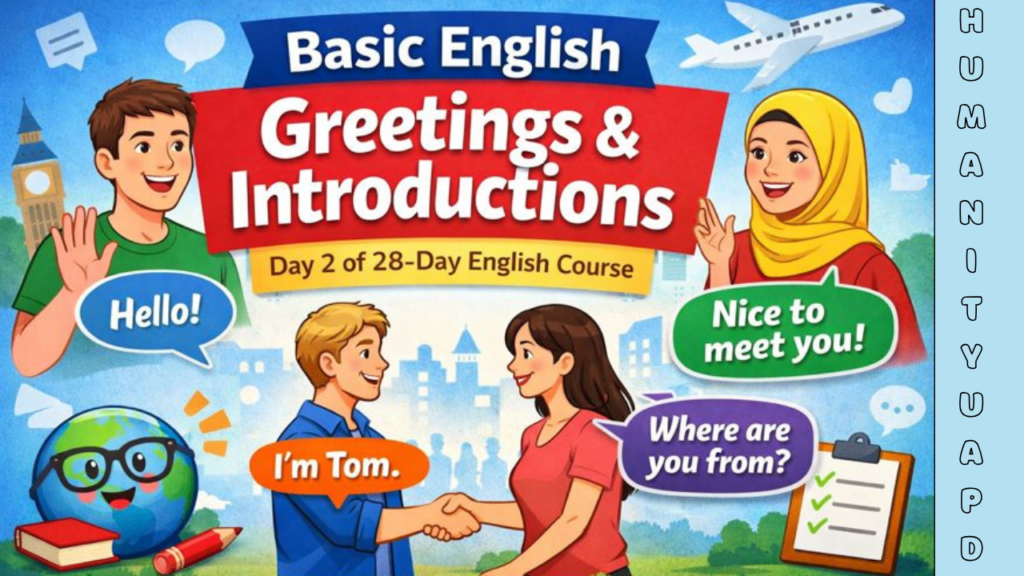
Basic English Greetings and Introductions
Greetings and introductions are the first steps in communication. When you meet someone for the first time or see people you know, the words you use help create a good first impression. Simple and polite greetings make conversations friendly and comfortable.
For English learners, learning basic greetings and introductions is very important. These simple phrases help you speak with confidence in daily life. They also help you understand social rules and communicate politely in both casual and formal situations, such as at work, school, or while traveling.
In this blog post, you will learn easy and useful phrases for basic English greetings and introductions. These phrases are common and can be used in real-life situations. You will also see examples that make learning simple and practical.
By practicing these greetings and introductions, you can build better connections and feel more confident when speaking English. Even small phrases can make a big difference in how you communicate and connect with others.
👉 Table of Contents 👇
Common English Greetings
In English-speaking countries, greetings play a vital role in social interactions. They not only initiate conversations but also establish a positive tone for the exchange. Here are some of the most common greetings used, along with contexts in which they are appropriate.
Hello is perhaps the most universally used greeting. Suitable for both formal and informal situations, it can be used when meeting someone for the first time or when greeting someone you know. For example, one might say, “Hello, I am Jane, nice to meet you,” upon introduction.
Hi is a more casual alternative to “hello.” It’s often used among friends, family, or in relaxed settings. For instance, you might say, “Hi! How was your weekend?” This greeting conveys a friendly familiarity, making it ideal for informal interactions.
Good morning is a polite greeting typically used from early morning until around noon. It sets a cheerful tone to the day’s interactions. When meeting colleagues in the office, for example, one might say, “Good morning, everyone! Ready for our meeting?”
Good afternoon is appropriately used between noon and approximately 6 PM. This greeting maintains a formal aspect, suitable for professional settings. It can be used in situations such as, “Good afternoon, Mr. Smith. How can I assist you today?”
Good evening is a greeting used after 5 or 6 PM, often in both formal and casual contexts. It can be appropriate when meeting friends for dinner or when addressing guests at an event. An example can be, “Good evening, it’s a pleasure to see you all here.”
By utilizing these common English greetings, individuals can foster a welcoming atmosphere and convey respect in their interactions, creating a foundation for successful communication.
Responding to Greetings
Responding to greetings is a fundamental aspect of communication, reflecting both respect and engagement in social interactions. When someone greets you, it is customary to reply in a manner that matches the tone and context of the greeting. Basic responses such as “Hi!” or “Hello!” are universally accepted and can be used in most casual situations.
For instance, if someone greets you with “Good morning!”, a polite reply could be, “Good morning! How are you?” This not only acknowledges the greeting but also invites further conversation. It’s important to tailor your response based on the context; for example, in a professional setting, responding with a more formal greeting like “Good morning, Mr. Smith” may be appropriate if addressing someone in a position of authority.
In more informal settings, you might encounter variations such as “Hey!” or “What’s up?” These greetings typically signal a friendly atmosphere. Appropriate responses could include “Hey! Not much, how about you?” or simply “Not much, you?” to continue the dialogue effectively.
Additionally, the time of day can influence the nature of your reply. For example, in the afternoon, responding to a “Good afternoon!” with a simple “Good afternoon!” is sufficient, but you can enhance your interactions by adding a follow-up question, such as “Good afternoon! How has your day been?” This encourages rapport building.
When engaging with someone in a different cultural context, it is crucial to be mindful of their greetings and responses. Some cultures may have specific ways of greeting that require unique responses. Overall, responding thoughtfully to greetings fosters positive communication, enhances relationships, and builds a conducive atmosphere for interaction.

Introducing Yourself in English
Introducing yourself in English is a fundamental skill that can significantly impact social interactions, professional networking, and overall communication skills. A well-structured self-introduction serves as a foundation for engaging with others effectively. Typically, a simple introduction can be divided into three key components: your name, your origin, and your profession.
To begin, you might say, “My name is [Your Name].” This straightforward phrase clearly conveys your identity and sets the stage for further discussion. Next, you can share your background with, “I am from [Your Country/City].” This detail not only provides context but can also prompt questions about your culture or experiences, fostering a more in-depth conversation.
The third component often involves your professional role. For instance, you can say, “I work as a [Your Job Title].” This statement not only informs others about your current occupation but might also spark conversations about shared interests or professional experiences.
To make your introduction more engaging, consider personalizing your approach. You can include a brief detail about what you enjoy in your work or a hobby that reflects your personality. For example, “I am a software engineer, and I love creating innovative solutions that make everyday tasks easier” can create a connection with individuals in similar fields or those interested in technology.
Moreover, maintaining eye contact, using a confident tone, and smiling can enhance your delivery, making your introduction more welcoming and less rehearsed. Practicing your introduction can also improve your comfort level when meeting new people, allowing you to engage in more fluid conversations. In essence, a clear structure combined with personal touches can make your self-introduction memorable and foster meaningful interactions.
Importance of Asking About Others
When engaging in a conversation, particularly after introducing oneself, the act of asking about the other person plays a crucial role in fostering connection and building rapport. This practice not only demonstrates genuine interest but also encourages a more balanced dialogue. Simple yet effective questions can significantly enhance the interaction between two individuals.
For instance, after sharing your own name and perhaps a brief introduction, it is customary to inquire, “What’s your name?” This fundamental question allows the other person to reciprocate, creating an environment of mutual exchange. Likewise, asking, “Where are you from?” can spark deeper discussions about backgrounds, cultures, and shared experiences. Such inquiries can lead to establishing common ground, which is foundational in nurturing relationships.
Additionally, questions like “What do you do?” serve not only as a means of gathering information but also provide both parties the opportunity to engage in conversations about their professions, interests, or passions. This sharing of information tends to enrich the conversation, creating pathways for further dialogue and exploration of topics that might be of joint interest.
Furthermore, the act of asking these questions can help mitigate awkwardness in social settings. When both parties engage in asking and answering questions, it can alleviate the pressure of carrying a one-sided conversation. Moreover, actively listening and responding thoughtfully to the answers can demonstrate respect and validation, strengthening the connection.
In essence, asking about the other person is an integral component of social interactions. By incorporating inquiries regarding names, origins, and occupations, individuals can develop a rapport that may lead to deeper relationships, whether personal or professional. Utilizing these engaging questions can make all the difference in creating meaningful interactions and lasting connections.
Formal vs. Informal Greetings and Introductions
Greetings and introductions are fundamental aspects of communication, and understanding the difference between formal and informal exchanges is crucial. In a formal context, the aim is to show respect and professionalism. Common formal greetings include “Good morning,” “Good afternoon,” or “Good evening,” often followed by the person’s last name or title, such as “Mr. Smith” or “Dr. Johnson.” In formal situations, such as business meetings or interviews, it is polite to use these greetings to establish an atmosphere of respect and seriousness.
On the other hand, informal greetings are used in casual settings and during familiar interactions. Phrases like “Hey!” or “Hi there!” are typical examples of informal greetings. These exchanges often occur among friends, family, or peers, allowing individuals to convey a sense of warmth and friendliness. Informal introductions typically involve first names, such as saying, “This is John,” rather than including a surname or title.
Choosing between formal and informal greetings depends on the context and the individuals involved. For instance, when meeting a prospective employer, one should prioritize formality to convey professionalism. Conversely, at a social gathering or among colleagues, informal greetings may create a relaxed and welcoming environment.
Additionally, regional and cultural differences can influence the choice of greeting and introduction style. In some cultures, formality is essential in most interactions, while in others, casual exchanges may be the norm. Thus, being aware of the specific context and cultural nuances is vital when deciding how to greet or introduce oneself appropriately. Understanding these distinctions ensures effective communication and helps forge positive impressions.
Cultural Considerations in Greetings
Understanding the cultural nuances that influence greetings and introductions is paramount in fostering effective communication. Different societies exhibit distinct norms regarding proximity, eye contact, and body language during these interactions. These factors can significantly alter the meaning and reception of a greeting, making it essential for individuals to be culturally aware.
Proximity, or the distance maintained during a conversation, varies widely across cultures. In some regions, such as Latin America and parts of the Middle East, individuals may stand closer together and engage in physical contact, such as hugs or kisses on the cheek, as a form of greeting. Conversely, in cultures such as those in Northern Europe, a greater physical distance may be preferred, with a firm handshake being the standard practice. Understanding these preferences can prevent discomfort and misinterpretation during greetings.
Eye contact is another critical component, with differing implications across cultures. For example, in many Western cultures, direct eye contact is perceived as a sign of confidence and sincerity. However, in several Asian cultures, prolonged eye contact may be viewed as disrespectful or confrontational. Recognizing the appropriate level of eye contact can help individuals navigate cultural sensitivities and convey respect during introductions.
Furthermore, body language plays a vital role in communication styles around the world. Gestures, personal space, and posture can express varying degrees of engagement or formality. For example, while a nod may indicate agreement in some cultures, it could have an entirely different significance elsewhere. Being aware of these subtleties in body language is essential for establishing rapport and ensuring that the intended message is accurately conveyed.

Practice Scenarios for Beginners
Practicing greetings and introductions is essential for beginners who wish to develop their English communication skills. Below are several simple dialogues and role-play scenarios designed for pairs or small groups. Each scenario encourages learners to practice different forms of greetings and introductions.
Scenario 1: Meeting a New Classmate
Participants can pretend to be classmates meeting for the first time at school. One student can initiate the conversation by saying, “Hi, I’m Alex. What’s your name?” The other, responding, can say, “Hello, Alex! I’m Jamie. Nice to meet you!” They can continue the dialogue by asking about each other’s interests, such as “What do you like to do in your free time?”
Scenario 2: Informal Gathering
In a casual setting, learners can simulate a friendly gathering among friends. One person might say, “Hey everyone! I’m Sarah, and I’ve recently moved here. How about you?” Responses from the other participants can include, “I’m Ben! Welcome to the neighborhood!” This encourages others to introduce themselves and share a little more about their backgrounds.
Scenario 3: Introduction in a Professional Setting
For a more formal approach, participants can role-play a business meeting. One might say, “Good morning, I’m Dr. Smith, the new project manager. It’s a pleasure to meet you all.” To respond, another could say, “Good morning, Dr. Smith. I am Linda, the marketing director. Welcome aboard!” This exercise helps familiarize learners with professional courtesy and context.
These practice scenarios provide practical opportunities for beginners to rehearse various greetings and introduction styles. By engaging in these dialogues, learners can become more comfortable in communicating effectively in English, thereby enhancing their confidence during real-life interactions. Encourage beginners to switch partners and roles to maximize their practice experience.
Conclusion and Encouragement for Practice
In this blog post, we have explored the fundamental aspects of English greetings and introductions. We have discussed various types of greetings, such as formal and informal approaches, and highlighted the importance of context when engaging in conversation. The art of making a good introduction was examined, and strategies for effective self-presentation were shared, providing you with a toolkit to enhance your communicative skills in English.
Understanding how to initiate a conversation through appropriate greetings and introductions is essential in building rapport and establishing connections with others. We emphasized the significance of expressing polite phrases, active listening, and engaging with clarity and confidence. As you interact in different social situations, remember that the first impression can often set the tone for the interaction that follows.
To truly master these essential English greetings and introductions, consistent practice is crucial. It is vital that you take the lessons learned from this post and apply them in real-life situations. Engage with friends, participate in language exchange groups, or even practice in front of a mirror. Through these methods, you can develop greater ease with the language, which will ultimately enhance your confidence.
As you progress, don’t hesitate to revisit this guide whenever you feel uncertain. Embrace opportunities for practice, and remember that every interaction is a chance to improve. With dedication and consistent usage of your newly acquired skills, you will witness remarkable growth in your English communication abilities. Stick with it, and enjoy the process of learning!
Frequently Asked Questions (FAQ)
What are basic English greetings and introductions?
Basic English greetings and introductions are simple words and phrases used to say hello, meet someone, and start a conversation. Examples include “Hello,” “Hi,” and “My name is…”.
What is the most common English greeting?
The most common English greeting is “Hello.” It is polite and can be used in both formal and informal situations.
How do beginners introduce themselves in English?
Beginners can introduce themselves using simple sentences like:
– “My name is Rahul.”
– “I am from India.”
– “I am a student.”
These sentences are easy and correct for everyday use.
What is the difference between formal and informal greetings?
Formal greetings are used in professional or polite situations, such as:
– “Good morning”
– “Good afternoon”
Informal greetings are used with friends or family, such as:
– “Hi”
– “Hey”
How should I reply to “How are you?”
You can reply with:
– “I’m fine, thank you.”
– “I’m good.”
– “Doing well, thanks.”
These are natural and polite responses.
Can I use “Hi” in professional situations?
Yes, you can use “Hi” in relaxed professional environments. However, in formal meetings or interviews, “Hello” or “Good morning” is safer.
Why are greetings and introductions important in English?
Greetings and introductions help you start conversations politely. They create a good first impression and make communication easier and more friendly.

Share this:

