
English for Phone Calls | Day 19 | 28-day free course

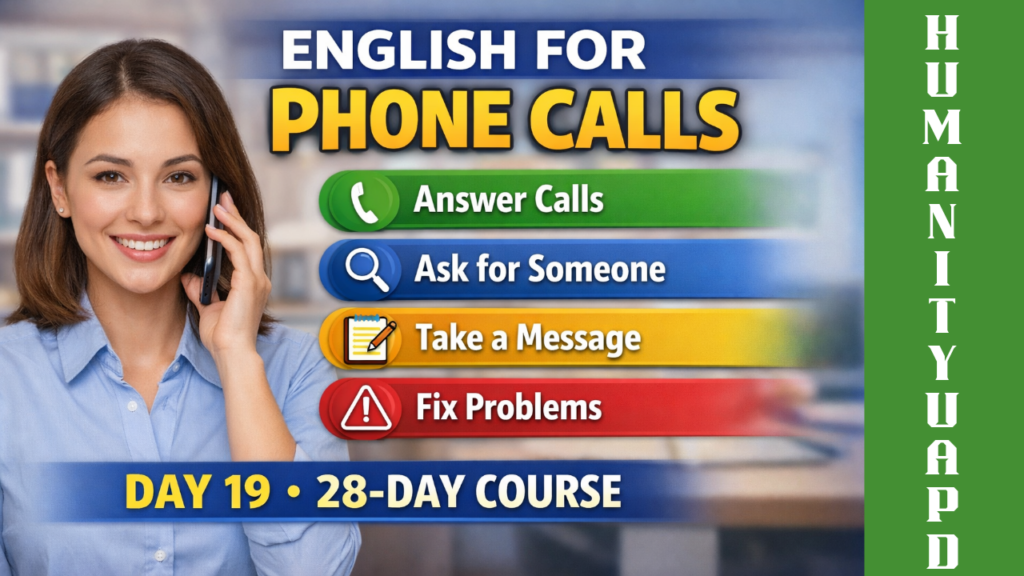
English for Phone Calls
Welcome to our comprehensive guide on mastering English for phone calls, a skill that can greatly enhance your communication abilities. Many beginners often find the prospect of speaking on the phone in English daunting. This apprehension is understandably fueled by several factors including unclear audio, swift speech patterns, and the challenge of translating thoughts from one’s native language into English. These obstacles can make phone calls seem intimidating and overwhelming.
However, it is important to recognize that these challenges are common among learners. Realizing that many individuals share similar experiences can serve as a source of comfort. The good news is that, with consistent practice, the complexities of making phone calls in English can be effectively navigated. The more exposure you have to various phone call scenarios, the more comfortable you will grow.
Over time, these experiences will not only develop your listening skills but also enhance your ability to articulate thoughts and respond dynamically in conversations. Furthermore, learning specific phrases and vocabulary tailored for phone calls can significantly ease this process. By familiarizing yourself with these linguistic tools, you will find that speaking on the phone becomes less of a hurdle and more of a routine task.
This guide is designed to assist you in refining your phone call skills effectively. Throughout the sections, we will delve into practical tips, essential vocabulary, and helpful strategies tailored for beginners. With regular practice and the right resources, your confidence will grow, and the art of making phone calls in English will transform from a daunting task into a manageable and enjoyable activity.
👉 Table of Contents 👇
Why Phone Call English Feels Difficult
Engaging in phone conversations can be particularly challenging for beginners learning English. Several factors contribute to this difficulty, making phone communication seem daunting. One of the primary reasons is the variation in accents. English speakers come from diverse regions, each with distinct pronunciations and regional slang. This can create confusion and hinder comprehension, particularly for learners who are not accustomed to specific dialects.
Additionally, the nature of phone calls itself poses unique challenges. Unlike face-to-face interactions, where visual cues such as facial expressions, gestures, and body language aid in understanding, phone calls rely solely on auditory communication. This absence of visual context can lead to misunderstandings. For example, if a caller speaks quickly or mumbles, it becomes much harder for beginners to grasp the intended message.
Furthermore, background noise can complicate matters, making it difficult to hear the other person clearly. A situation might arise where a learner is trying to follow a discussion in a bustling café or a crowded office, and external sounds can distract them, leading to missed information. This auditory overload can increase anxiety and put additional pressure on learners to respond, which is often overwhelming.
The pressure of speaking without visual aids adds to the challenge. Beginners may feel nervous about making mistakes or not pronouncing words correctly, which can hinder their ability to express themselves fluently. It is important to remember, however, that these struggles are common among language learners worldwide. Everyone encounters these obstacles when navigating phone conversations.
Through consistent practice and exposure to various speaking situations, learners can gradually improve their phone call English skills. They should embrace these difficulties as a part of the learning process and recognize that improvement comes with persistence and patience.
Answering a Phone Call
When answering a phone call in English, using basic phrases can help set a professional tone and make communication smoother. Two common phrases that can be immediately utilized are “Hello?” and “Good morning/afternoon/evening.” These phrases serve as a polite way to greet the caller and acknowledge their presence.
For instance, when responding to a phone call, one might say, “Hello? This is [Your Name]. How can I help you today?” This format helps not only in greeting but also introduces oneself, establishing a connection right from the start. It is important to speak clearly and at a moderate pace to ensure that the caller understands you.
Here’s a simple dialogue to illustrate how these phrases can be applied during a phone call:
Caller: Good morning! Is this John?
Receiver: Hello! Yes, this is John. How can I assist you?
Caller: Hi John, this is Sarah calling from ABC Company. I wanted to discuss our upcoming meeting.
Receiver: Of course, Sarah! What would you like to cover?By practicing these phrases, learners can become more comfortable with phone etiquette. By integrating phrases like these into your routine, you will find that answering calls becomes easier. Understanding the importance of a proper introduction and greeting will enhance your confidence while communicating over the phone.

Asking for Someone
When making phone calls, knowing how to ask for someone is crucial for clear communication. Two common expressions used in such situations are “May I speak to ___?” and “Is ___ available?” Both of these phrases serve to request the presence of a specific person on the line.
The phrase “May I speak to ___?” is a polite way to inquire about the availability of an individual. For instance, if you are calling a business to speak with a manager named John, you would say, “May I speak to John, please?” This shows respect and acknowledges the recipient’s position and time.
Alternatively, the phrase “Is ___ available?” can also be used when you are unsure if the person is currently at their desk or available for a conversation. For example, you might ask, “Is Sarah available to talk?” This phrase naturally incorporates additional context about the situation, particularly in professional settings where availability may vary.
Let’s consider a mini-conversation using these phrases:
Caller: “Good afternoon, may I speak to Mr. Smith, please?”
Receptionist: “May I ask who is calling?”
Caller: “This is Alex from the marketing department.”
Receptionist: “Thank you, let me check if Mr. Smith is available.”
In another example:
Caller: “Hello, is Emily available?”
Assistant: “I’m sorry, she is currently in a meeting. Would you like to leave a message?”
Practicing these phrases can significantly boost your confidence during phone conversations. Repeating them aloud and incorporating them into everyday interactions will help you become more comfortable when asking for someone over the phone. Aim to utilize these expressions in various scenarios to enhance your English proficiency.
Taking a Message
When you receive a phone call and the person you are speaking to is not available, it is essential to know how to take a message correctly. This skill is particularly useful in a professional setting, ensuring that communication flows smoothly even in the absence of the intended recipient. One important phrase to remember is, “Can I take a message?” This question indicates that you are willing to help and pass along any important information.
If the caller wishes to leave a message, you can note down the relevant details, such as their name, the time of the call, and the purpose of their call. It is also helpful to ask for additional contact information if necessary. For example, you might say, “Could you please provide me with your phone number or email address?” This ensures that the person you are taking a message for can get back in touch.
In circumstances where you need to inform the caller that the individual they are trying to reach is unavailable, you can use phrases like, “I’m sorry, but he/she is not available right now.” Follow this up with a solution, such as, “Would you like to leave a message?” or “Can I have him/her call you back later?” These responses not only maintain professionalism but also show the caller that their inquiry is valued.
For example, if someone calls asking for a manager who is out of the office, you could respond with, “I’m sorry, the manager is not here at the moment. Can I take a message for you? I will tell him/her about your call.” This approach ensures clarity and reinforces courteous communication.
Ending a Phone Call Politely
Ending a phone call gracefully is an essential skill in effective communication, especially for beginners learning English. Politeness plays a crucial role in leaving a good impression on the person you are speaking with. A simple phrase such as “Thank you for calling” conveys appreciation and respect, making the conversation end on a positive note.
Another common way to conclude a call is by saying “Goodbye”. This straightforward expression is universally understood and suitable for both formal and casual interactions. Depending on the context, you may also want to add a friendly touch by saying “Talk to you later” if you anticipate future conversations with the individual. This phrase creates a sense of continuity and connection.
Consider the following dialogue examples that illustrate these phrases in context:
Example 1:
Caller: “I appreciate your time today. I have to get going now. Thank you for calling!”
Receiver: “Thank you! Goodbye!”
Example 2:
Caller: “It was great speaking with you. Talk to you later!”
Receiver: “Absolutely! Talk to you later. Goodbye!”
It is important to note that how you end a conversation can leave a lasting impression. Using polite phrases not only reflects well on you but also paves the way for positive future interactions. Remember to always match your tone and choice of words to the nature of the call, whether it is a business-related discussion or a casual chat with a friend.
Common Phone Call Problems
Engaging in phone calls can be challenging for learners of English, especially when faced with certain common issues. One prevalent problem is the inability to hear the other person clearly. For instance, someone might say, “Sorry, I can’t hear you. Can you speak up?” This scenario often arises due to poor connection, background noise, or the caller speaking too softly.
In such cases, it is essential to address the situation politely yet directly. You might say, “Could you please speak a bit louder? I’m having trouble hearing you.” This approach communicates your difficulty while also fostering a respectful dialogue.
Another frequent issue occurs when a learner does not fully understand what was said. Phrases like “Can you repeat that?” become necessary to ensure clarity. It is crucial to use this phrase gracefully. A more polite alternative could be, “I’m sorry, I didn’t catch that. Could you please repeat it?” When used appropriately, such requests not only clarify the conversation but also display a willingness to engage meaningfully.
Additionally, learners may find themselves struggling with fast speech from the caller. In this situation, asking the person to speak slowly is a practical solution. You might say, “I apologize, but could you speak a bit more slowly? I want to make sure I understand you correctly.” This kind of request can significantly improve comprehension and comfort levels during the call.
By preparing for these common challenges, learners can engage more effectively in English phone calls, ensuring smoother communication and building their confidence in conversational skills.

Practice Section
Practicing English for phone calls can significantly enhance your communication skills. Below are three simple role-play scenarios that you can practice with a partner or by yourself. These exercises focus on different aspects of phone conversations to improve your fluency and confidence.
Scenario 1: Answering the Phone
In this scenario, you will practice how to answer a phone call politely. One person acts as the caller and the other as the receiver. The caller will start the conversation. For example, “Hello, this is Sarah. Is John available?” The receiver should respond, “Hello, Sarah. Thank you for calling. Let me check if John is in.” This exercise helps learners to get familiar with common phrases used when answering calls.
Scenario 2: Asking for Someone
The second scenario involves asking for someone on the phone. One person can be a caller, and the other can be a receptionist or the person answering the phone. The caller might say, “Hi, I would like to speak with Mr. Smith, please.” The receiver would respond, “Sure, may I ask who is calling?” This role play reinforces the importance of identifying oneself while making a request.
Scenario 3: Taking a Message
In the final scenario, practice taking messages. The caller may say, “Could you please tell Emily to call me back? My number is 555-1234.” The receiver will practice taking the message correctly by repeating it back: “So, I will inform Emily to call you at 555-1234. Is that correct?” This exercise emphasizes the clarity needed in communication and the accuracy of information exchange.
In addition to these scenarios, repeating short practice sentences can enhance fluency. Try saying the following sentences aloud:
1. “Can I speak to Mr. Johnson, please?”
2. “I will call you back later.”
3. “Thank you for your patience!”
4. “Could you please hold on a moment?”
5. “May I leave a message?”
Conclusion and Encouragement
As we conclude this guide on English for phone calls, it is important to reiterate the significance of practice in mastering communication skills. Engaging in phone conversations, even when it feels daunting, is a vital component of learning a new language. Each call presents an opportunity to apply the skills you have developed, from introducing yourself to requesting information. These skills are not just theoretical; they are practical tools that will enhance your ability to communicate effectively.
Throughout this journey, you may encounter moments of uncertainty or make mistakes. It is essential to recognize that these experiences are a natural and beneficial part of the learning process. Each error can provide valuable lessons that contribute to your growth as a speaker. Therefore, instead of shying away from potential pitfalls, embrace them as stepping stones towards fluency.
To build confidence, seek out opportunities for practice. Whether it is through conversation exchanges, language apps, or simply engaging with friends who speak English, every interaction is a chance to improve. Remember, even seasoned speakers continued to refine their skills through practice and perseverance. Celebrate small victories along the way, as these milestones indicate progress.
In summary, nurturing your ability to engage in phone conversations in English requires patience, dedication, and a consistent approach to practice. Each session you undertake enhances your familiarity with the language and boosts your self-assurance. Keep pushing boundaries, and remember that each effort you make brings you one step closer to becoming a more confident communicator. Every practice session is a valuable investment in your linguistic journey.
Frequently Asked Questions – English for Phone Calls
Why is speaking English on the phone harder than face-to-face conversation?
Because you cannot see facial expressions or body language. You must rely only on listening skills, which makes understanding accents and fast speech more challenging.
What should I say when answering a phone call in English?
You can say:
“Hello?”
“Good morning.”
“This is [Your Name]. How can I help you?”
Example:
“Hello, this is AP. How may I assist you?”
How can I politely ask to speak to someone?
Use phrases like:
“May I speak to ___, please?”
“Is ___ available?”
“Could I talk to ___?”
These are polite and professional expressions.
What do I say if the person is not available?
You can say:
“I’m sorry, he/she is not available right now.”
“Would you like to leave a message?”
“Can I take a message?”
How do I take a message correctly?
Write down:
✔ Name of the caller
✔ Phone number
✔ Reason for calling
✔ Time of the call
Then repeat it to confirm:
“Let me repeat that to make sure I understood correctly.”
What if I cannot hear the caller clearly?
Say:
“Sorry, I can’t hear you clearly.”
“Could you please speak up?”
“The line is breaking up.”
What if I don’t understand something?
Politely ask:
“Could you repeat that, please?”
“I’m sorry, I didn’t catch that.”
“Could you say that again more slowly?”
How can I end a phone call politely?
Use phrases like:
“Thank you for calling.”
“It was nice speaking with you.”
“Have a great day.”
“Goodbye.”
How can beginners practice phone call English?
– Practice role-plays with friends.
– Record yourself speaking.
– Listen to English business call examples.
– Repeat useful phone phrases daily.
How long does it take to feel confident on phone calls?
With daily practice (10–15 minutes), many learners feel more confident within 2–4 weeks.
Is it okay to make mistakes during phone calls?
Yes. Mistakes are a natural part of learning. Focus on communication, not perfection.

Share this:

