
Making Your First English Sentences – English Course (2026)

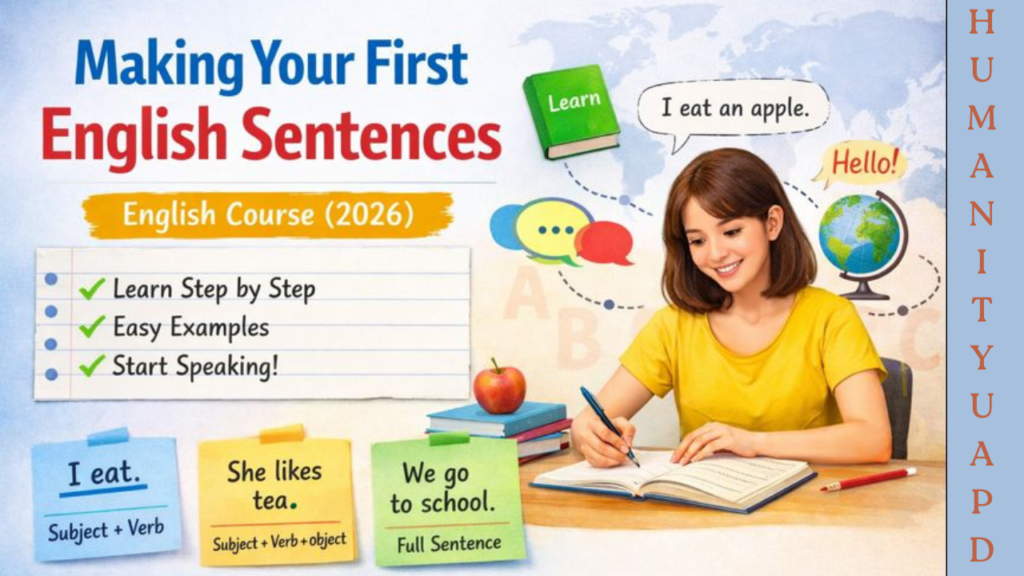
Making Your First English Sentences
The ability to form sentences is a crucial skill in mastering the English language. A sentence is essentially a group of words that convey a complete thought or idea. It typically consists of a subject and a predicate, which together express an action or a state of being. Without sentences, it would be challenging to share information, express feelings, or engage in meaningful conversations. Thus, understanding sentence formation is pivotal for anyone embarking on their journey to learn English.
Communication is at the heart of language learning. By constructing sentences, learners can articulate their needs, ask questions, and share experiences. This foundational skill enables you to connect with others effectively and enhances your overall understanding of the language. The more comfortable you become with creating sentences, the more confident you will feel in your ability to communicate. This confidence can facilitate further language acquisition, as well as improve social interactions.
For those new to English, the thought of creating sentences may seem daunting, but it is important to approach this task with a positive mindset. Remember that every expert was once a beginner. Start with simple structures, such as subject-verb-object combinations, and gradually build on these as you gain more proficiency. Practice is key; the more you engage with sentence construction, the more fluid and natural it will become. Seek opportunities to express yourself, whether it is through writing in a journal or speaking with others. Embrace the process, and allow yourself the freedom to experiment and make mistakes, as this is an essential part of the learning journey.
👉 Table of Contents 👇
Understanding the Basic Components of a Sentence
When learning to construct sentences in English, it is crucial to understand the three fundamental components that make up a basic sentence: the subject, the verb, and the object. Each of these elements plays a vital role in communicating a complete thought.
The subject of a sentence is the person, place, thing, or idea that is doing or being something. For example, in the sentence “The dog barks,” the subject is “the dog.” It is the entity performing the action of barking. Identifying the subject is essential, as it indicates who or what the sentence is about.
The verb follows the subject and indicates the action being performed or the state of being. In our previous example, “barks” is the verb. It describes the action that the subject, the dog, is undertaking. Verbs can take various forms and may indicate different tenses, which allows speakers to convey time-related aspects of actions.
Finally, the object of a sentence receives the action from the verb. For instance, in the sentence “The cat chased the mouse,” the subject is “the cat,” the verb is “chased,” and the object is “the mouse.” The object provides additional information about who or what is affected by the action of the verb. Without the object, the sentence might convey an incomplete thought.
These three components – subject, verb, and object – work together to form a complete sentence. Mastering these elements is essential for learners aiming to enhance their English sentence construction skills. Understanding how they interact will enable one to communicate effectively and formulate coherent sentences, laying a solid foundation for further language development.
Starting with Simple Subject-Verb Structures
When constructing your first English sentences, it is advisable to start with the simplest form: the subject-verb structure. This basic framework lays a strong foundation for more complex sentence construction. The subject typically represents who or what the sentence is about, while the verb indicates the action or state of being.
For example, the sentence “The cat sleeps” illustrates a straightforward subject-verb construction. Here, “the cat” serves as the subject, while “sleeps” is the verb. Other variations can include different subjects and verbs, such as “The dog barks” or “The teacher explains.” Such combinations highlight the flexibility and simplicity of using this structure.
It is beneficial to practice forming sentences with various subjects and verbs to strengthen your understanding. Daily life offers ample opportunities for such practice. You might say “I eat,” where “I” is the subject and “eat” is the action. Other examples can include “They run” or “She reads,” each demonstrating how the choice of subject and verb can alter the meaning while keeping the structure intact.
Furthermore, consider the inclusion of plural subjects to enrich your practice. For instance, “The children play” or “The birds sing” exemplify subject-verb combinations where the subjects consist of plural nouns. Engaging with different forms of subjects and various action words will not only enhance your vocabulary but also solidify your grasp of English syntax.
As you become more comfortable with simple sentences, you will find it easier to expand your writing skills into more intricate grammatical structures. Practicing these fundamental sentence forms will pave the way for future learning, setting the stage for complex sentence creation. Thus, immerse yourself in creating basic subject-verb sentences as they are the cornerstone of effective communication in English.

Adding Objects to Enhance Your Sentences
To construct meaningful and engaging English sentences, it is essential to incorporate objects, both direct and indirect. Objects provide additional information and can describe who is receiving the action or what is being acted upon. Utilizing objects effectively can considerably enhance the depth and clarity of your sentences.
Direct objects are the nouns or pronouns that receive the action of the verb directly. For example, in the sentence “The teacher reads the book,” the word “book” serves as the direct object, specifying what the teacher is reading. This infusion of detail transforms a basic sentence into a more informative one.
On the other hand, indirect objects indicate to whom or for whom the action of the verb is performed. To illustrate, consider the example “She gave her friend a gift.” Here, “her friend” is the indirect object, while “a gift” remains the direct object. By including both types of objects, the sentence becomes richer, providing clarity about who benefits from the action.
Common verbs often pair with specific objects, enhancing their meaning. For instance, using the verb “to give” typically requires both direct and indirect objects, as seen in phrases like “I gave my brother a book” or “They taught the students English.” In each case, the direct object (book, English) indicates what is involved, while the indirect object (brother, students) reveals who is affected by the action.
In essence, adding objects allows for a more nuanced expression in your sentences. By carefully selecting both direct and indirect objects, you can create sentences that convey greater detail and engage your reader more effectively. This method not only enriches your writing but also enhances your overall communication skills in English.
Using Adjectives and Adverbs for More Detail
In English, adjectives and adverbs serve as essential components for enriching sentences and conveying more precise meanings. Adjectives are words that modify nouns or pronouns, allowing writers to provide more information about a subject. For instance, in the sentence “The tall man walked briskly,” the adjective “tall” adds a descriptive element to the noun “man,” helping the reader visualize his height. Without the adjective, the sentence would lack this detail, leading to a less vivid understanding of the subject.
Similarly, adverbs modify verbs, adjectives, or other adverbs, often clarifying the manner, timing, or degree of the action. In the example “She sings beautifully,” the adverb “beautifully” modifies the verb “sings” and gives insight into how she performs. This additional information enhances the reader’s perception of the action being described. By incorporating both adjectives and adverbs, a sentence becomes more engaging and informative.
Moreover, the strategic placement of these modifiers can significantly change the meaning or tone of a sentence. Consider the difference between “The fast runner won the race” and “The slow runner won the race.” The change of just one adjective shifts the entire interpretation of who achieved victory. Thus, adjectives and adverbs are invaluable tools in English, as they can transform simple sentences into more complex and expressive statements.
To summarize, utilizing adjectives and adverbs effectively is fundamental for constructing well-rounded English sentences. Their ability to provide detail not only enriches the text but also aids in creating clarity and nuance within the written word.
Practicing with Simple Sentences
Learning to form simple sentences is an essential step in mastering the English language. To aid in this process, it’s beneficial to use prompts or scenarios that inspire creativity while encouraging learners to construct sentences. For instance, consider the prompt: “What do you see in the park?” Learners can create sentences like, “I see a dog playing with a ball” or “A child is flying a kite.” These straightforward constructions help learners begin to express ideas clearly and concisely.
To enhance sentence building, it is important to encourage expanding on these initial simple sentences. One way to do this while maintaining simplicity is by prompting learners to add details. For example, responding to the previous prompt, a learner might expand their sentence to, “I see a happy dog playing with a bright red ball in the sunny park.” Here, emotional and contextual details breathe life into the basic sentence structure without significantly complicating it.
Images can also serve as effective tools for fostering sentence creation. By presenting learners with a picture of a bustling market, they might formulate sentences like, “There are many fruits on the table” or “A woman is buying flowers.” This method not only aids in vocabulary acquisition but also reinforces the structure of simple sentences. Encouraging learners to describe each aspect of the image helps solidify their understanding of how to construct meaningful sentences.
Incorporating supportive activities, such as sentence-building games or writing exercises based on real-life scenarios, can further assist learners in practicing their skills. The aim is to progressively develop their confidence in forming complete thoughts while embracing the simplicity of English sentences. Through continuous practice, learners can refine their abilities and begin to engage more fluently with the language.
Common Mistakes to Avoid When Forming Sentences
When learning to construct sentences in English, beginners often encounter a variety of pitfalls that can hinder effective communication. One of the most prevalent mistakes is related to subject-verb agreement. This occurs when the subject and verb do not match in number (singular or plural). For example, saying “The group are going to the park” is incorrect; the proper form should be “The group is going to the park,” since a group is treated as a singular entity.
Another frequent error arises from incorrect word order. English typically follows a Subject-Verb-Object (SVO) structure. For instance, saying “She the apple eats” deviates from standard syntax. The correct formulation would be “She eats the apple.” It is crucial for learners to familiarize themselves with the proper arrangement of words in sentences to ensure clarity and comprehension.
Punctuation mistakes also present significant challenges for beginners. The misuse of commas, periods, and question marks can alter the meaning of a sentence or make it difficult to read. Consider the difference between “Let’s eat, Grandma” and “Let’s eat Grandma”; the first sentence implies an invitation to dine, while the second suggests an alarming scenario. To avoid such confusion, it is important to practice punctuation rules and their implications.
To mitigate these common mistakes, learners should engage in regular reading and writing exercises. Analyzing well-structured sentences in books or articles can provide valuable insights into syntax, punctuation, and style. Seeking feedback from proficient English speakers can also help identify areas for improvement. Ultimately, being aware of these common errors and proactively addressing them can significantly enhance one’s ability to form accurate and effective sentences in English.

Building Confidence Through Regular Practice
Establishing a foundational confidence in forming English sentences is pivotal for language learners. One of the most effective ways to achieve this is through consistent and dedicated practice. Regularly engaging with the language allows learners to experiment, make mistakes, and learn from them in a supportive environment. This reinforces understanding and enhances fluency.
A valuable practice exercise involves daily journaling. Each day, take a few minutes to write a short paragraph describing your day, your thoughts, or anything that interests you. This not only contributes to daily sentence formation but also encourages personal reflection. Furthermore, complex structures can be incorporated as comfort with simple sentences develops, gradually challenging oneself to express more complex ideas.
Another approach is to participate in conversation exchanges, either in person or online. Connecting with native speakers or fellow learners provides real-time feedback, which aids in refining sentence construction and vocabulary usage. Furthermore, using language learning apps can facilitate daily practice with structured lessons that focus on sentence formation exercises, thus reinforcing skills through repetition.
Engaging with media such as books, movies, or podcasts can also enhance understanding of sentence structure and usage. Listening or reading can be followed by summarizing content or discussing it with others. This encourages active thinking in English and promotes the formation of sentences in context, essential for real-world applications.
In summary, building confidence in forming English sentences is a gradual process that thrives on regular practice and diverse activities. By integrating exercises such as journaling, conversation exchanges, and media interactions into daily routines, learners can steadily improve their language skills and gain the confidence needed to express themselves effectively in English.
Conclusion and Next Steps
In this guide, we have explored the fundamental concepts necessary for constructing your first English sentences. We began by understanding the importance of sentence structure, emphasizing the roles of subjects, verbs, and objects. By practicing these components, learners can create clear and effective sentences that communicate their intended messages.
Additionally, we discussed various techniques to enhance vocabulary acquisition and grammatical accuracy. Engaging with interactive activities, such as sentence-building games and language apps, can significantly improve your ability to form sentences confidently. Such approaches are beneficial for both beginners and those looking to refine their skills further.
As you embark on your journey to mastering English sentence construction, regular practice is essential. Consider setting aside time each day to write simple sentences related to your daily life or interests, as this will help reinforce your learning. You may also want to join language exchange programs or English conversation groups, which provide real-life opportunities to practice speaking.
For continued development, a wealth of resources is available. Online platforms such as Duolingo, Grammarly, and language-specific forums can be invaluable for reinforcing your skills. Moreover, books dedicated to English grammar and sentence structure can offer structured guidance for self-study.
In summary, the key to becoming proficient in forming sentences lies in consistent practice and the use of diverse resources. By applying what you have learned and seeking out additional materials, you will build a solid foundation for your English language journey. Remember, every sentence you create is a step toward fluency and effective communication.
FAQs – Making Your First English Sentences
What is the easiest way to start making English sentences?
The easiest way is to start with simple sentences. Use this pattern:
Subject + Verb + Object
Example: I eat food.
Practice short sentences every day.
How many words do I need to make my first English sentence?
You only need two or three words to start.
Examples:
– I eat.
– She runs.
– They play.
Simple sentences are perfect for beginners.
Do I need to learn grammar before making sentences?
No. You do not need advanced grammar in the beginning.
First, learn basic sentence structure and practice speaking and writing. Grammar will improve naturally with practice.
How can I practice making English sentences every day?
You can practice by:
– Writing 3–5 sentences about your day
– Describing what you see around you
– Speaking sentences aloud
– Using English learning apps or videos
Daily practice builds confidence.
What mistakes should beginners avoid when making sentences?
Common mistakes include:
– Wrong word order
– Forgetting the verb
– Using the wrong verb form
Do not worry about mistakes. Learning comes from correcting them.
How long does it take to learn basic English sentence making?
With daily practice, beginners can start making simple sentences in 2–4 weeks. Consistency is more important than speed.
Is it okay to make mistakes while learning English sentences?
Yes, absolutely. Making mistakes is a normal and important part of learning English. Every mistake helps you improve.
What should I learn after making my first English sentences?
After basic sentences, you should learn:
– Questions in English
– Negative sentences
– Tenses (present, past, future)
– Speaking practice
This course will guide you step by step.

Share this:

