
Nouns Explained Simply: Easy English Guide (Day 3–Day 28)

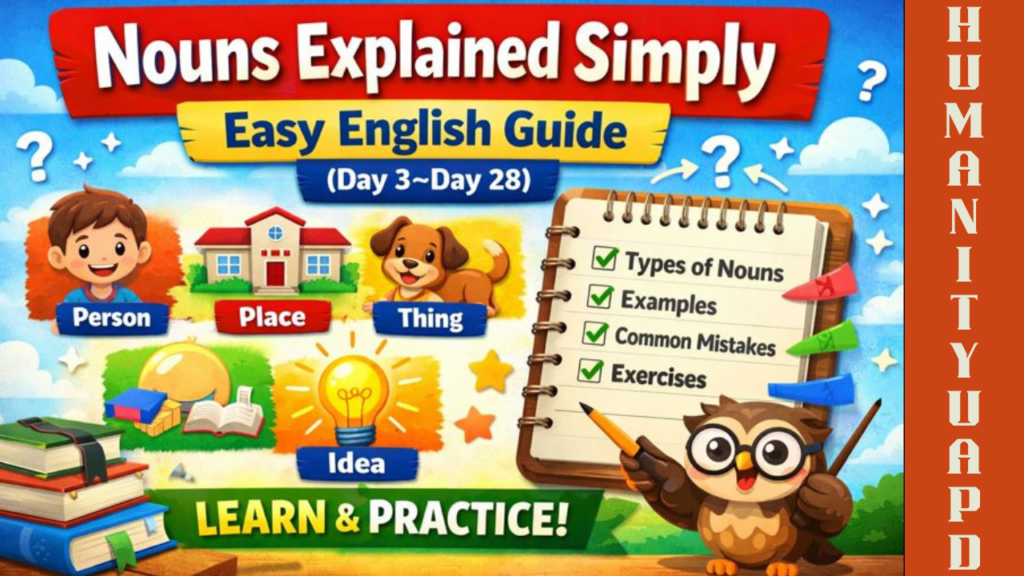
Nouns Explained Simply
Nouns are the building blocks of language, serving as the primary means by which we denote people, places, things, and ideas. They play a crucial role in English and are fundamental in constructing sentences that allow us to communicate our thoughts effectively. Understanding nouns is essential not only for native speakers but also for those learning English as a second language, as they form the foundation of everyday conversations.
In its simplest form, a noun refers to any name, such as ‘dog,’ ‘school,’ or ‘happiness.’ These terms represent various entities and concepts we encounter in daily interactions. For instance, when someone says, “I saw a cat in the park,” the words “cat” and “park” are nouns identifying a specific animal and a location. You can often find nouns appearing as the subject of a sentence, as in “The teacher explains the lesson,” where “teacher” is the noun performing the action.
Nouns can be categorized into several types, including common nouns, proper nouns, concrete nouns, and abstract nouns. Common nouns refer to general items (e.g., ‘fruit,’ ‘city’), while proper nouns specify individual names (e.g., ‘London,’ ‘Sarah’). Concrete nouns are tangible objects (e.g., ‘apple,’ ‘car’), while abstract nouns encapsulate intangible concepts (e.g., ‘freedom,’ ‘synergy’). This variety allows speakers and writers to convey detailed and nuanced meanings.
In summary, a solid grasp of nouns enables individuals to engage in effective communication, making it easier to express ideas and connect with others. Their significance in the English language cannot be overstated, as they are indispensable for both verbal and written expression.
👉 Table of Contents 👇
What is a Noun?
A noun is a part of speech that refers to a word that names a person, place, thing, or idea. Understanding nouns is essential for grasping the basics of language. Nouns can be simple and direct, like ‘cat’ for a pet or ‘library’ for a specific location where books are kept. They can also represent more abstract concepts, such as ‘freedom’ or ‘happiness’. In essence, if you can identify something that exists in the world or a thought that you can think about, there is likely a noun to describe it.
There are several categories of nouns that can be helpful for understanding how they function in language. For instance, common nouns refer to general items or concepts, such as ‘city’ or ‘teacher’. In contrast, proper nouns designate specific entities, like ‘New York’ or ‘Ms. Smith’, and they are always capitalized to signify their uniqueness.
Nouns can also take on different roles within a sentence. They can act as the subject, which is the person or thing performing an action, as in the sentence “The dog barked.” Here, ‘dog’ is the noun that is the subject of the action. Additionally, nouns can serve as objects or possessive forms, showing ownership, as in “the artist’s painting.” This versatility makes nouns fundamental building blocks for constructing meaningful sentences.
In conclusion, recognizing nouns and their uses is critical for effective communication. They are the words that anchor our conversations, providing clarity and context, whether we are discussing tangible items or abstract notions.
Types of Nouns
Nouns are fundamental components of the English language, and they can be categorized into several types based on their characteristics. Understanding these different types enhances clarity and communication. Below are some of the main types of nouns.
Common Nouns are general names for a person, place, thing, or idea, and they do not require capitalization. Examples include ‘city’, ‘dog’, and ‘happiness’. These nouns serve to denote items in a broad, general sense, allowing for the identification of categories rather than specific instances.
Proper Nouns, in contrast, are unique identifiers that specify particular entities and are always capitalized. For instance, ‘London’, ‘Rover’, and ‘Christmas’ represent distinct names. Proper nouns provide specificity and distinction, setting individuals or groups apart from others in the same class.
Concrete Nouns refer to items that can be perceived through the senses, such as ‘apple’, ‘music’, or ‘rain’. These nouns are tangible and can be experienced physically, making them essential for descriptive language.
Abstract Nouns represent ideas, qualities, or conditions that cannot be experienced through the senses. Examples include ‘freedom’, ‘love’, and ‘justice’. These nouns often embody complex concepts and emotions, allowing for a rich expression of human experience.
Countable Nouns are those that can be counted and have a singular and plural form, such as ‘book’ (one book, two books). They represent discrete items and can be paired with numbers. On the other hand, Uncountable Nouns refer to substances or concepts that cannot be counted individually, like ‘water’, ‘information’, and ‘furniture’. These nouns typically do not have a plural form and require special modifiers.
By familiarizing oneself with these categories of nouns, one can gain a deeper comprehension of their usage, significantly enhancing writing and communication skills.

Common Nouns
Common nouns are a fundamental part of speech in the English language. They refer to general items, people, places, or ideas, rather than specifying a unique entity. Common nouns are not capitalized unless they appear at the beginning of a sentence. Examples include words like “dog,” “city,” and “happiness.” These nouns can be contrasted with proper nouns, which denote specific names and are always capitalized, such as “Fido,” “New York,” or “Joy.” Understanding common nouns facilitates effective communication by allowing individuals to refer to the general concept rather than the particular instance.
For instance, when one says, “The cat sat on the mat,” both “cat” and “mat” are common nouns. They do not refer to a specific cat or mat, but rather to any cat or mat in general. Another example could be, “We traveled to the mountains for a vacation.” In this sentence, the word “mountains” emphasizes a category of location without specifying which mountains are being referenced.
Common nouns can also describe professions, such as “teacher” or “doctor,” as well as items and subjects encountered in daily life, like “book,” “car,” or “school.” In phrases like, “The children played in the park,” the terms “children” and “park” again represent general entities. This approach to language helps in expressing thoughts in a clear and straightforward manner.
By recognizing and using common nouns effectively, individuals enhance their language skills, allowing for more fluid conversations and written communication. They are indispensable in constructing sentences that convey everyday ideas and actions, forming the backbone of simple yet effective discourse.
Proper Nouns
Proper nouns are a specific category of nouns that name individual entities, distinguishing them from generic categories. They refer to unique people, places, organizations, or sometimes things, and are always capitalized to indicate their distinct nature. This capitalization sets proper nouns apart from common nouns, which refer to general items or concepts without the need for capitalization.
For instance, while “city” is a common noun that could refer to any city in the world, “New York” is a proper noun because it specifies a particular city on the map. Similarly, “teacher” is a common noun, whereas “Mr. Smith” or “Dr. Jane Doe” are proper nouns, as they indicate specific individuals with their own identities. The distinction between proper and common nouns is essential in writing and communication, as it helps convey precise information and context.
Examples of proper nouns can be found in various domains. In the context of geography, one could reference “Mount Everest,” which is the specific name of a tallest mountain in the world, in contrast to the common noun “mountain” which lacks specificity. In literature, the title of a novel, for instance, “Pride and Prejudice,” is a proper noun, whereas the term “book” is a common noun. Likewise, in the realm of brands, “Coca-Cola” is a proper noun indicating a particular company, while “soda” is a broad category that might encompass various brands.
In conclusion, understanding proper nouns is crucial for effective communication. Their distinct nature, highlighted by capitalization and specificity, allows for clarity and precision when naming unique entities in both writing and conversation.
Concrete Nouns vs. Abstract Nouns
Nouns are essential components of language, classifying people, places, things, and ideas. They can be categorized into two major types: concrete nouns and abstract nouns. Understanding these distinctions is fundamental to grasping the nuances of language.
Concrete nouns refer to physical objects or entities that can be perceived through the senses. Specifically, these nouns denote things that one can see, hear, touch, taste, or smell. For example, the word “apple” represents a tangible object that one can hold, observe, and taste. In a simple sentence, one might say, “She took a juicy apple from the basket.” Here, “apple” serves as a concrete noun, illustrating its ability to be experienced physically.
On the other hand, abstract nouns express concepts, ideas, or qualities that are not physically tangible. These cannot be sensed directly and often represent feelings, traits, or states of being. For instance, the term “happiness” signifies an emotional state rather than a physical object. To see abstract nouns in action, consider the sentence, “His happiness was evident when he smiled.” In this example, “happiness” is an abstract noun, highlighting its intangible nature.
The key difference between concrete and abstract nouns lies in their perceptibility. While concrete nouns ground our understanding by referencing the physical world, abstract nouns invite us to explore more abstract concepts and emotions. Both types of nouns play crucial roles in enriching our language and enabling effective communication. In sum, recognizing whether nouns are concrete or abstract can enhance our appreciation of the nuances present in our language, allowing for clearer and more precise expressions in both speaking and writing.
Countable and Uncountable Nouns
Nouns are categorized based on whether they can be counted or not. This major distinction is between countable and uncountable nouns. Countable nouns refer to items or entities that can be counted. These nouns have a singular and a plural form, which allows us to specify quantities effectively. For example, the word “apple” is countable as one can say “one apple” or “two apples.” Common examples include items such as “books,” “chairs,” and “children.” When utilizing countable nouns in everyday language, it is typical to see phrases such as “many cars,” “few friends,” or “several options,” all of which reflect varying quantities.
In contrast, uncountable nouns represent substances or concepts that cannot easily be counted due to their indivisible nature. They typically do not have a plural form and are often associated with mass nouns or collective concepts. For instance, “water,” “sand,” and “information” are uncountable. When discussing such nouns, expressions using terms like “some sugar,” “much time,” or “less knowledge” are appropriate. In practical terms, when dealing with uncountable nouns, one emphasizes a more abstract quantity rather than specific numbers.
To clarify, consider the two categories in everyday usage: “I drank three glasses of water” (where “glasses” is countable, and “water” is uncountable) or “There are twelve cookies on the plate” (in which “cookies” represents countable nouns). Understanding the difference between countable and uncountable nouns is essential for accurate communication and effective language usage, particularly in contexts where precision is paramount.

Common Mistakes with Nouns
When learning about nouns, particularly for non-native speakers, several common mistakes can impede language proficiency. Understanding these pitfalls is crucial for effective communication. One frequent error involves the misuse of countable and uncountable nouns. For instance, saying “informations” instead of “information” is incorrect since “information” is an uncountable noun. To avoid this mistake, one must know which nouns are countable and which are not, ensuring proper usage during conversations or writing.
Another prevalent mistake is confusion between singular and plural forms. A classic example is the misapplication of the plural form in sentences such as “sheep”. Both the singular and plural forms of this noun are “sheep”; hence, using it in a sentence like, “two sheeps are grazing” is incorrect. To prevent this, learners should pay attention to the irregular plural forms that exist in English and practice them regularly.
Additionally, learners often confuse possessive nouns with contractions. For example, writing “its” when referring to possession, in contrast to “it’s,” which stands for “it is.” A practical strategy to avoid this is to read sentences aloud, allowing for a clearer distinction between the two forms based on context.
Similarly, a frequent error is the incorrect use of nouns in collective forms. For instance, using “team are winning” instead of “team is winning” disregards the collective noun rule, where a team is treated as a singular entity. Understanding these grammatical structures will enhance clarity and convey correct meanings.
By recognizing and addressing these common mistakes with nouns, learners can significantly improve their writing and speaking skills, allowing for clearer and more effective communication.
Practice Exercises and Answers
To reinforce your understanding of nouns, this section provides a series of practice exercises designed to help you identify and fill in nouns in various contexts. Completing these exercises will improve your ability to recognize nouns and their applications in everyday language.
For each exercise, read the sentences carefully and fill in the blank spaces with the appropriate nouns. Remember that nouns can be proper, common, collective, or abstract. Take your time to think about what type of noun fits best in each context.
Exercise 1: Fill in the blanks with suitable nouns:
- My favorite animal is a ______.
- This ______ is known for its delicious fruit.
- The ______ gathered at the park for a picnic.
Exercise 2: Identify and write down all the nouns in the following sentences:
- The teacher gave her students a challenging assignment.
- Basketball players practice their skills every afternoon.
- The beauty of nature is often captured in art.
Once you have completed the exercises, refer to the answers provided below to check your work and enhance your understanding of nouns.
Answers:
Exercise 1:
- dog (or any appropriate animal)
- tree (or any appropriate plant)
- group (or people, family, etc.)
Exercise 2:
- teacher, students, assignment
- Basketball, players, skills, afternoon
- beauty, nature, art
Continue practicing with these exercises and use them as a resource for studying different types of nouns. Consistent practice will solidify your understanding of nouns and their varied usage.
FAQs: Nouns Explained Simply
What is a noun in simple words?
A noun is a word that names a person, place, thing, or idea. For example, in the sentence “The dog ran to the park,” both “dog” and “park” are nouns. Nouns are fundamental components of sentences, providing essential information about who or what is being discussed.
How many types of nouns are there?
There are several types of nouns in English, generally categorized into common nouns, proper nouns, collective nouns, abstract nouns, and concrete nouns. Common nouns refer to general items (e.g., “city,” “car”), while proper nouns denote specific names (e.g., “London,” “Toyota”). Understanding these categories aids in grasping the varied functions nouns perform in language.
What is the difference between common and proper nouns?
The main difference lies in specificity. Common nouns refer to general items or entities (e.g., “teacher,” “river”), while proper nouns uniquely identify specific individuals or places (e.g., “Mr. Smith,” “Amazon River”). Proper nouns are always capitalized, setting them apart from common nouns.
Why are nouns important in English?
Nouns play a crucial role in communication by providing clarity and context to sentences. They serve as the subjects or objects in sentences, ensuring effective exchange of ideas. Without nouns, it would be challenging to convey thoughts or identify elements within an expression. Additionally, nouns contribute to the richness and structure of language, enhancing overall comprehension.
Conclusion
In closing, understanding nouns is a fundamental aspect of mastering the English language. Nouns play a vital role in sentence construction as they name people, places, things, and ideas, forming the backbone of conversation and writing. By practicing nouns daily, learners can enhance their vocabulary and comprehension skills. This daily practice will not only solidify their grasp of nouns but also improve their overall language proficiency.
It is crucial for learners to explore various lessons and resources available on the topic of nouns. These materials can offer insights into different types of nouns, such as proper nouns, common nouns, and collective nouns, which are essential for effective communication. Engaging with exercises, quizzes, and real-life applications can further reinforce the understanding of nouns.
As learners continue to navigate through the complexities of English, a strong foundation in nouns will facilitate clearer expression and better comprehension. Whether it is through reading, writing, or conversational practice, the consistent application of knowledge about nouns will yield significant benefits. Thus, investing time in mastering nouns will undeniably lead to greater confidence and competence in the English language.
Therefore, take the time to practice, reflect, and learn about nouns. The journey of mastering this critical component of language can be rewarding, paving the way for advanced linguistic skills in the future.

Share this:

