
Prepositions In-On-At | Amazing Course | Day 11 (2026)

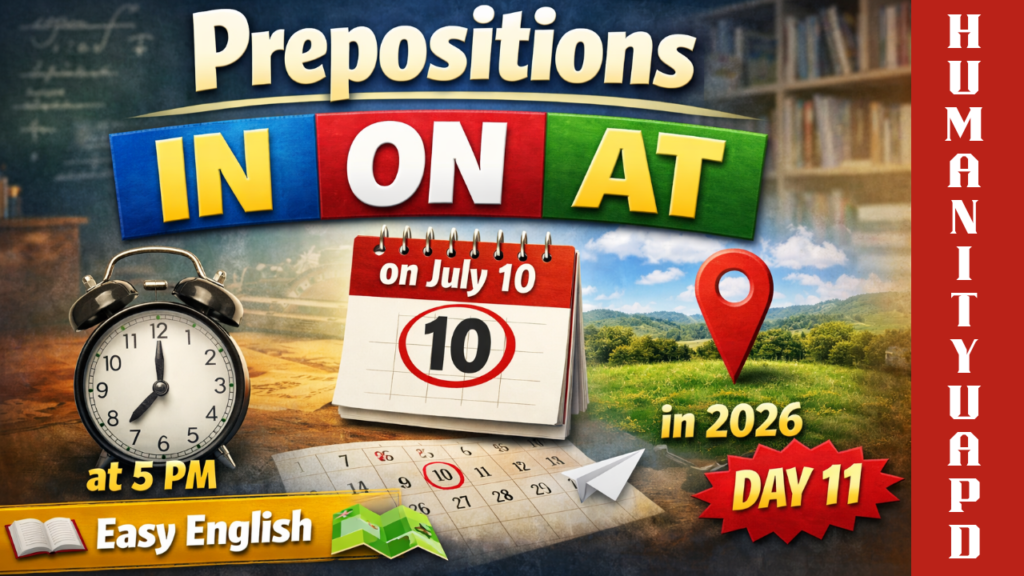
Prepositions In-On-At
Prepositions are essential components of English grammar that serve to establish relationships between different elements within a sentence. Specifically, they connect nouns, pronouns, or phrases to other words, clarifying how they interact within the context of a statement. By doing so, prepositions play a crucial role in conveying various types of relationships, primarily concerning time, place, and direction.
In the realm of language, prepositions function as a bridge that links different parts of a sentence. For example, in the phrase “The book is on the table,” the preposition “on” connects the noun “book” to the noun “table,” indicating a spatial relationship. Similarly, prepositions can also indicate time, as illustrated in the sentence “We will meet after lunch,” where “after” denotes a relationship concerning temporal sequencing. Additionally, prepositions can express direction, as shown in the sentence “She walked toward the park,” where “toward” indicates the direction of movement.
Furthermore, prepositions often require the use of objects. In many cases, a preposition is followed by a noun or pronoun to complete its meaning, forming what is known as a prepositional phrase. For instance, in the phrase “at the store,” “at” is the preposition, and “the store” serves as its object. This combination provides listeners and readers with a clearer understanding of the spatial context being described.
In summary, the role of prepositions in English cannot be overstated. They facilitate communication by helping to articulate relationships, whether they pertain to location, timing, or movement. Recognizing the significance of prepositions in constructing meaningful sentences is a foundational aspect of mastering English grammar.
👉 Table of Contents 👇
Types of Prepositions
Prepositions are essential components in English grammar, serving to connect nouns, pronouns, or phrases to other words within a sentence. They can be categorized into various types, including prepositions of time, place, direction, and agent. Each type has distinct functions and examples that illustrate their usage effectively.
Prepositions of Time indicate when something occurs. Common examples include “at,” “on,” and “in.” For instance, one might say, “The meeting is scheduled for at three o’clock,” where “at” specifies a particular time. Additionally, “on” is used for days and dates, as in “The event occurs on Saturday,” while “in” is often employed for months or years, like in “She was born in 1990.”
Prepositions of Place denote the location of an object or person. Terms such as “in,” “on,” and “at” serve this purpose. For example, “The book is on the table” explains where the book is situated, whereas “John is in the office” indicates a more enclosed space. The preposition “at” can be used as well, as in “She is at the mall,” suggesting a specific point rather than a volume of space.
Prepositions of Direction help illustrate the direction towards which someone or something moves. Examples include “to,” “towards,” and “through.” For example, “He walked to the store” shows the destination of the action. The word “towards” can express movement in the direction of something, illustrated by “She ran towards the finish line,” whereas “through” indicates movement within an area, as in “The river flows through the valley.”
Prepositions of Agent represent the entity performing an action, typically expressed through the preposition “by.” For instance, in the sentence, “The book was written by George Orwell,” the preposition “by” identifies the author. This category helps establish a connection between an action and its source.
By categorizing prepositions this way, one can better understand their roles within sentences, thus enhancing comprehension and usage in both spoken and written English.
Common Prepositions Used in English
Prepositions play a significant role in the English language, linking nouns, pronouns, or phrases to other words in sentences. Among the most frequently used prepositions in English, five stand out due to their versatility and frequency of use: in, on, at, for, and about. Understanding these prepositions can greatly improve both comprehension and articulation in English.
The preposition in indicates inclusion within a space or time frame. For example, when one says, “The cat is in the box,” it signifies that the cat is contained within the boundaries of the box. Similarly, “in September” specifies that an event occurs during that month.
On is often used to denote a surface or a specific day. Phrases like “on the table” suggest that an object rests upon the surface of the table. Additionally, when referring to days, as in “on Monday,” it clarifies the time an event takes place.
Moving on to at, this preposition typically pinpoints an exact location or moment. An example would be, “She is at the park,” indicating her precise whereabouts. In terms of time, saying “at noon” conveys a very specific time during the day.
For is used to indicate purpose or duration. For instance, “This gift is for you” reveals the intended recipient of the gift, while “for two hours” indicates an extended duration of time.
Lastly, about is employed to convey the subject of a discussion or consideration. Saying, “We are talking about the weather” identifies the topic being discussed.
Overall, mastering these common prepositions can enhance one’s command of English, facilitating clearer communication and improved writing skills.

How to Use Prepositions Correctly
Mastering the usage of prepositions in English is crucial for clear and effective communication. While prepositions are often small words, their correct placement can significantly impact the meaning of a sentence. One of the fundamental rules is to understand the relationship between the noun and its action. Prepositions typically link nouns, pronouns, or phrases to other words in a sentence, thus establishing spatial, temporal, or abstract relationships.
Common errors in preposition usage often arise from a misunderstanding of these relationships. For instance, using incorrect prepositions in expressions such as “interested for” instead of ”interested in” can confuse the reader. To avoid such mistakes, it is advisable to familiarize oneself with common prepositional phrases and their appropriate contexts. Engaging with authentic language sources, such as literature or reputable news articles, can provide examples of proper preposition use.
Another guideline involves prepositional placement, especially regarding adjective-noun and verb-noun constructions. When using verbs that naturally require prepositions, such as “belong to” or “depend on,” it is essential to ensure that the preposition follows the verb closely to maintain clarity. Additionally, the positioning of prepositions at the end of a question or clause is grammatically sound in informal English, though more formal constructions usually place them preceding the related noun.
Furthermore, non-native speakers should pay attention to collocations—combinations of words that frequently occur together. This can aid in selecting the correct preposition, as certain verb-preposition combinations might not follow the expected patterns. To master preposition usage, continual practice, and exposure are recommended. Engaging in exercises that challenge one’s understanding can solidify knowledge and enable more effective application in both written and spoken contexts.
Prepositional Phrases and Their Importance
Prepositional phrases serve as essential components of the English language, enriching sentences with detail and providing clarity. A prepositional phrase typically consists of a preposition followed by a noun phrase, which can include a noun, pronoun, or noun equivalent. For example, in the phrase “under the bridge,” “under” is the preposition, and “the bridge” serves as the noun phrase. This structure allows for a more vivid description of relationships between different elements in a sentence.
The importance of prepositional phrases lies in their ability to convey a variety of meanings that enhance comprehension. They help specify time, location, direction, and other contextual details that might otherwise be ambiguous. For instance, in the sentence “The book is on the table,” the prepositional phrase “on the table” clarifies where the book is located, thereby eliminating any confusion. Similarly, a phrase such as “after the meeting” indicates a specific timeframe, allowing for a more precise understanding of when an action will occur.
Moreover, prepositional phrases contribute to the overall flow of language, enabling the construction of complex and compound sentences. By linking phrases to subjects and verbs, they create a more elaborate structure that reflects intricate ideas and relationships. This cohesion is vital in both spoken and written communication, as it aids in guiding the reader through the narrative or argument being presented.
In essence, mastering the use of prepositional phrases is crucial for effective communication. They not only enhance the texture of sentences but also fortify the clarity required for successful interactions in both informal and formal contexts. By incorporating prepositional phrases skillfully, writers can achieve greater precision and nuance in their expression.
The Challenge of Prepositions for Language Learners
For many language learners, mastering the use of prepositions presents a significant challenge. Prepositions are essential components in the structure of English sentences, often indicating relationships in terms of time, space, or direction. Non-native speakers frequently struggle with choosing the appropriate preposition, as several English words do not have direct translations in their native languages. This complication is further compounded by the idiomatic nature of many prepositional phrases, which may not follow logical patterns.
For instance, the phrase “in the car” may seem straightforward, but understandings may differ based on cultural context. Some learners might confuse this with “on the car” or “at the car,” depending on their first language’s structure. Such discrepancies can lead to misunderstandings and hinder effective communication. Additionally, numerous idiomatic expressions, such as “in a hurry” or “under pressure,” add yet another layer of complexity that learners must navigate. Mastering these idioms requires not only memorization but also cultural awareness.
To enhance one’s grasp of prepositions, consistent practice is vital. Engaging in conversations with native speakers can illuminate subtle uses of prepositions in context, aiding comprehension. Language learners should also utilize resources such as cross-reference dictionaries and grammar guides, which clarify common usages and contextual applications. Furthermore, it can be beneficial to create flashcards of commonly used prepositional phrases, allowing learners to reinforce their understanding of usage through repetition.
Participating in language exchange programs or utilizing apps that focus on speaking can also provide practical insights into prepositional usage. These strategies collectively assist learners in overcoming the challenges associated with prepositions and improve their overall command of the English language.
Examples of Prepositions in Sentences
Prepositions play a crucial role in English grammar by connecting nouns, pronouns, or phrases to other words in a sentence. To better understand their function, it is helpful to explore various examples that illustrate how prepositions establish clear relationships between elements.
For instance, consider the sentence: “The cat sat on the mat.” Here, the preposition “on” indicates the relationship between the cat and the mat, clarifying where the cat is positioned. Without the preposition, the spatial context of the cat’s location would remain vague.
Another example is: “She walked through the park.” The preposition “through” conveys not only the action of walking but also the path taken within the park. This use of preposition enhances the understanding of movement in relation to the location.
Similarly, in the sentence: “He is between the two buildings,” the preposition “between” specifies the subject’s place relative to the structures. This demonstrates how prepositions can help define spatial relationships, providing clarity that allows readers or listeners to visualize scenarios more effectively.
Furthermore, consider the example: “The file is under the stack of papers.” Here, the preposition “under” clarifies the position of the file, giving precise information about its location in relation to the pile. Such usage is essential in both spoken and written communication.
Lastly, in the sentence: “They will meet after lunch,” the preposition “after” establishes a temporal relationship, indicating when the meeting will occur. This usage of prepositions not only enhances grammar but also provides context that is vital for comprehension.

Fun Exercises to Master Prepositions
Prepositions are essential components of English grammar, connecting nouns, pronouns, and phrases to various parts of a sentence. To improve one’s understanding and usage of prepositions, engaging in interactive exercises is beneficial. Below are a variety of exercises designed for different proficiency levels, allowing learners to practice and refine their skills.
Beginner Level: Start with fill-in-the-blank exercises where learners choose the correct preposition from a list to complete sentences. For example, “The cat is hiding ___ the table.” (Options: under, on, in). This simple exercise helps beginners grasp the basics of where and how prepositions fit into sentences.
Intermediate Level: As learners gain confidence, they can move to matching exercises, where they align sentences with the appropriate prepositions. An example would be matching “I look forward ___ seeing you” with the correct option “to”. This level encourages learners to think about prepositions in different contexts.
Advanced Level: Advanced learners can benefit from context-based exercises, such as reading passages with omitted prepositions. Participants must fill in the blanks based on the surrounding context, which enhances comprehension and the ability to apply prepositions in more complex structures. For example, “She is fond ___ painting landscapes” requires a more nuanced understanding.
Quizzes and Games: Incorporating quizzes can also make learning prepositions enjoyable. Online platforms offer preposition quizzes where users receive immediate feedback on their answers. Games like “Preposition Bingo” encourage social learning and engagement among peers, reinforcing the concepts through fun interactions.
By practicing with these exercises, learners at all levels can effectively strengthen their command of prepositions, facilitating smoother and more accurate communication in English.
Conclusion: The Importance of Mastering Prepositions
In summation, prepositions are an integral component of English grammar that play a crucial role in shaping our expressions and clarifying relationships between words in a sentence. They serve as connectors that indicate direction, location, time, and various other relationships, thereby enhancing the coherence and precision of communication. Mastering prepositions is vital for anyone looking to improve their command of the English language, as a strong grasp of these grammatical elements can significantly elevate one’s writing and speaking skills.
The various categories of prepositions, whether they pertain to time, space, or other abstract relationships, all contribute to the richness of the language. Effective use of prepositions ensures that the intended message is communicated clearly and accurately. Misuse or misunderstanding of prepositions can lead to ambiguity and confusion, which may undermine the effectiveness of communication.
Moreover, the importance of practicing prepositions cannot be overstated. Regularly engaging with prepositional phrases in reading, writing, and speaking can reinforce understanding and help solidify the rules governing their usage. Language learners, in particular, should focus on prepositions as they can often be challenging due to their contextual nature and the subtle nuances that come with different expressions. By incorporating prepositions into daily practice, individuals can foster a more fluid and articulate style of communication.
Ultimately, mastery of prepositions enriches one’s ability to convey ideas clearly and effectively, which is essential in both personal and professional spheres. As you continue your journey in understanding English grammar, make a concerted effort to integrate prepositions into your skill set, ensuring that you communicate with confidence and clarity.
Frequently Asked Questions (FAQs): Prepositions In-On-At
What are prepositions in English?
Prepositions are small words that show the relationship between a noun or pronoun and another word in a sentence.
They often indicate time, place, direction, or cause.
When do we use IN, ON, and AT for time?
AT → exact time (at 5 PM, at noon)
ON → days and dates (on Monday, on 10 July)
IN → months, years, long periods (in March, in 2026, in the morning)
When do we use IN, ON, and AT for place?
IN → inside something (in the room, in the car)
ON → on a surface (on the table, on the wall)
AT → specific point or location (at school, at the bus stop)
Why are prepositions difficult for learners?
Because many prepositions do not translate directly from other languages and are often used in fixed phrases like “interested in” or “afraid of.”
What is a prepositional phrase?
A prepositional phrase includes a preposition + its object.
Example: in the room, on the table, at night.
Can a sentence end with a preposition?
Yes.
Ending a sentence with a preposition is common in spoken and informal English, such as:
“Who are you talking to?”
What are common mistakes with prepositions?
Some frequent errors:
❌ interested for → ✔ interested in
❌ married with → ✔ married to
❌ depend of → ✔ depend on
How can I improve my preposition usage?
– Practice daily sentences
– Read English books and articles
– Learn phrases, not single prepositions
– Do grammar exercises regularly
Are prepositions important for speaking English fluently?
Yes. Correct prepositions make your English clear, natural, and professional in both speaking and writing.
What should I learn after IN, ON, and AT?
Next, you should study:
– Prepositions of direction (to, into, onto, from)
– Common prepositional phrases
– Phrasal verbs with prepositions

Share this:

