Present Tense | learn English in 28 days | Absolutely Free

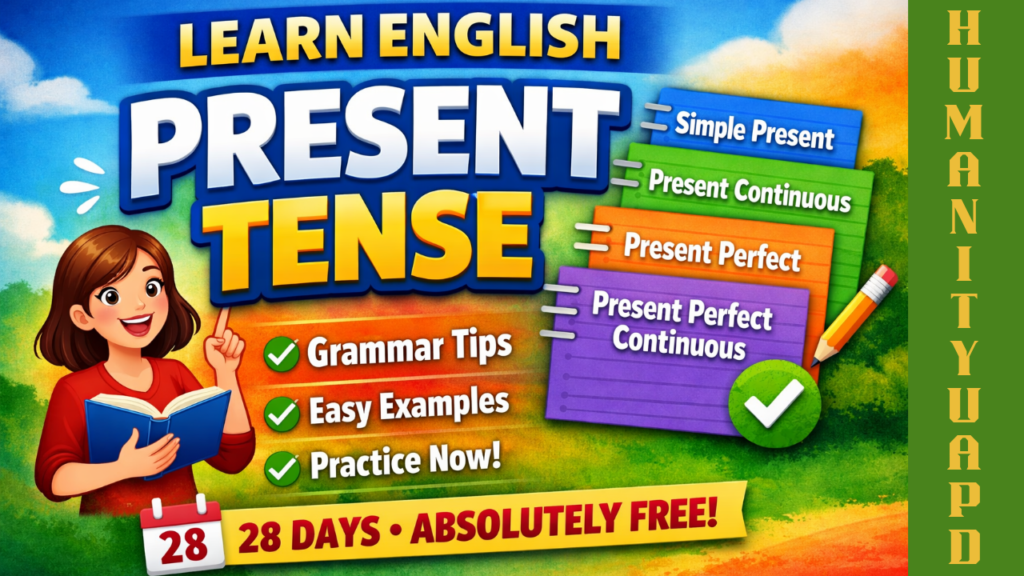
Present Tense
In the English language, verb tenses play a crucial role in conveying the timing of actions and events. Tenses essentially serve as grammatical tools that allow speakers and writers to organize thoughts in relation to time. Among the various tenses, the present tense holds a significant position due to its frequent application in daily communication and written expression. It serves not only as a means of stating facts but also as a way to express habits, current situations, and general truths.
Understanding tenses can greatly enhance one’s proficiency in English. Each tense illuminates a different aspect of time, allowing for precise and effective communication. The present tense, for instance, generally indicates actions that are happening now or are habitual in nature. This aspect of the present tense is vital for everyday interactions, such as in conversations where individuals share experiences, express opinions, or describe their routines.
Moreover, the use of the present tense is not limited to spoken language; it is equally applicable in writing. Writers often rely on the present tense to convey immediacy and relevance in their narratives, making the text more engaging for readers. By integrating the present tense into one’s writing, authors can create a direct connection with their audience, drawing them into the unfolding action or argument.
In summary, the present tense, as a pivotal component of English verb tenses, assists in structuring dialogues and narratives. As we delve deeper into the specifics of the present tense, it is essential to appreciate its foundational role in effective communication within the English language.
👉 Table of Contents 👇
What is the Present Tense?
The present tense is a grammatical term used to convey actions and states that occur in the current moment or regularly. It serves as a vital aspect of language enabling speakers and writers to articulate immediate occurrences and habitual activities. In English, the present tense can be categorized into four distinct forms, each serving unique purposes and contexts.
The first form, known as the simple present tense, is utilized to express general truths, habitual actions, or scheduled events. For example, the sentence “She reads every morning” demonstrates a regular occurrence that is part of one’s routine. This form is often recognized for its straightforward structure using the base form of the verb, with the addition of an “s” for the third-person singular.
The second form is the present continuous tense, which highlights actions currently in progress at the time of speaking. For example, “He is reading a book right now” illustrates an action that is actively unfolding. This tense is formed using the auxiliary verb “to be” combined with the present participle of the main verb, typically ending in “ing.”
Next, the present perfect tense describes actions that have occurred at some indefinite time in the past but have relevance or consequences in the present. An example sentence would be, “They have completed the project,” which indicates that the action happened but is still pertinent to the current situation. This construction uses the auxiliary verb “have” followed by the past participle of the main verb.
Lastly, the present perfect continuous tense emphasizes the duration of an activity that began in the past and continues to the present moment. For instance, “She has been studying for three hours” not only mentions the action but also highlights its ongoing nature. This form is created using “have been” along with the present participle of the main verb.
Forms of Present Tense
The present tense in English is primarily categorized into two forms: Simple Present and Present Continuous. Each of these forms serves distinct functions, showcasing the versatility of present-tense usage.
Simple Present
The Simple Present tense is commonly used to express habitual actions, universal truths, and facts that remain constant over time. It follows a straightforward structure where the base form of the verb is utilized. For example:
- Subject + base verb (add ‘s’ or ‘es’ for third-person singular)
- Examples:
- I play tennis on weekends.
- She reads books every night.
- Water boils at 100 degrees Celsius.
In questions, one typically employs auxiliary verbs such as “do” or “does”:
- Examples:
- Do you enjoy music?
- Does he play the piano?
Present Continuous
The Present Continuous tense, on the other hand, is used to indicate ongoing actions occurring at the moment of speaking or plans for the future. This form is characterized by the auxiliary verb “to be” followed by the present participle (verb + -ing). The structure includes:
- Subject + is/am/are + present participle
- Examples:
- I am studying for my exams.
- They are playing soccer right now.
- We are meeting our friends later.
Questions are formed similarly to the Simple Present, utilizing the relevant form of the auxiliary verb:
- Examples:
- Are you coming to the party?
- Is she working on her project?

Usage of Simple Present Tense
The simple present tense plays a vital role in the English language, serving various significant purposes that help in conveying facts, habits, and routines. Understanding its usage can enhance clarity and precision in communication.
One of the primary applications of the simple present tense is to state factual information. This tense is often employed to describe universal truths or scientific facts that remain constant. For example, the sentence “Water boils at 100 degrees Celsius” illustrates how the simple present tense effectively communicates a universally accepted fact. Similarly, one might say, “The Earth revolves around the Sun,” utilizing the tense to convey something that is always true.
The simple present tense is also crucial for discussing habits and regular activities. This usage reflects actions that occur repeatedly or are part of an individual’s routine. For instance, consider the sentence “She runs every morning.” In this case, it highlights a habitual action, suggesting that running in the morning is a regular part of her daily routine. Another example can be seen in the phrase, “They visit their grandparents on Sundays,” which indicates a repeated action that takes place on a specific day of the week.
Moreover, the simple present tense is frequently used in instructional contexts. When giving directions or explaining how to complete a task, the simple present provides clarity. An example would be, “To make tea, boil water and steep the leaves.” Here, the tense conveys a process that can be easily followed by the reader.
In summary, the simple present tense is integral to the English language, functioning effectively in stating facts, describing habits, and providing instructions. Its straightforward application enhances both spoken and written communication, making it essential for anyone looking to improve their language proficiency.
Usage of Present Continuous Tense
The present continuous tense is used to describe actions that are occurring at the moment of speaking or ongoing actions that are happening right now. This tense is formed by using the auxiliary verb “to be” in the present form (am, is, are) followed by the root form of the main verb with an -ing ending. For instance, one might say, “She is reading a book” to imply that the reading activity is presently taking place.
Additionally, the present continuous tense can convey planned future actions, as in the statement, “We are meeting our friends tomorrow.” Even though this meeting occurs in the future, the structure remains the same, emphasizing the arrangement of plans that are already in place. This dual function makes the present continuous tense quite versatile in everyday conversation.
However, certain common mistakes are often made when using the present continuous tense. A frequent error is to use it with stative verbs that express states rather than actions. For instance, saying “I am knowing the answer” is incorrect, as the verb “know” is a stative verb that describes a condition rather than a transient activity. In contrast, appropriate examples include action-oriented verbs, such as “I am enjoying this meal” or “They are playing football.” This highlights the need for careful selection of verbs when utilizing the present continuous tense.
In conclusion, the present continuous tense is an important linguistic tool for describing current and ongoing actions, as well as planned future events. Proper usage, alongside awareness of common mistakes, can enhance effective communication in both spoken and written forms.
Present Perfect Tense Explained
The present perfect tense is a critical component of English grammar that expresses actions or states linking the past to the present. The structure of the present perfect includes the auxiliary verb “have” or “has” followed by the past participle of the main verb. For example, in the sentence “She has visited Paris,” “has” is the auxiliary verb, and “visited” serves as the past participle.
This tense is particularly useful for conveying different situations associated with past actions. One of the primary uses is to talk about experiences. For example, if someone states, “I have seen that movie,” they suggest that at some point in their life, they experienced watching the movie, which may be relevant to the current conversation. It does not specify when the action took place, thus emphasizing the experience rather than the timing.
Another application of the present perfect tense is to indicate changes over time. A sentence like “My brother has grown taller” implies that the change in height happened at an unspecified time and may be ongoing or relevant to the present moment.
Furthermore, the present perfect tense serves to express completed actions that have significance in the present. For instance, saying “They have completed the project” indicates that the project was finished, but its results may still be pertinent, such as affecting current projects or meetings.
In conclusion, the present perfect tense is a versatile tool that allows speakers to connect past actions to present circumstances, encompassing experiences, changes, and completed actions. Mastering its structure and uses can substantially enhance one’s proficiency in English communication.
Present Perfect Continuous Tense Usage
The present perfect continuous tense is an essential grammatical structure in English that connects past actions to the present moment. It is formed using the auxiliary verbs ‘have’ or ‘has,’ followed by ‘been,’ and the present participle of the main verb. For instance, one might say, “I have been studying English for three years.” This construction highlights the ongoing nature of an action that commenced in the past and continues to occur in the present.
One of the primary uses of the present perfect continuous tense is to describe actions that have recently been completed but still have relevance or impact on the current situation. For example, “She has been working hard on her project, and it is finally finished.” In this case, the emphasis is on the continuous effort put into the project, demonstrating that while the project is now complete, the process itself was significant.
Moreover, this tense can effectively express the duration of an action that began in the past and is still ongoing. Consider the example “They have been living in this city since 2010.” Here, the present perfect continuous tense lets the listener know not only that the action started in the past but also that it continues to this day. This usage is significant in contexts where understanding the timeframe of an ongoing action is crucial.
Furthermore, the present perfect continuous tense can convey a sense of frustration or annoyance regarding an ongoing situation. For instance, “I have been waiting here for an hour!” This conveys urgency and emphasizes the ongoing nature of the speaker’s experience.
In conclusion, the present perfect continuous tense serves as a versatile tool in English language usage. By bridging the past with the present, it vividly portrays ongoing experiences and highlights the relevance of past actions in the current context.

Common Mistakes and Tips
When mastering the present tense, language learners often encounter several common pitfalls that can hinder their progress. One typical error is the incorrect use of the simple present tense, particularly with third-person singular subjects. Learners frequently forget to add an “-s” or “-es” to the verb, resulting in sentences like “He play soccer” instead of the accurate “He plays soccer.” This omission can change the meaning of a sentence, so paying close attention to subject-verb agreement is crucial.
Another mistake arises when learners overuse the present continuous tense. While expressions of ongoing actions are common in everyday conversation, there are instances where the simple present tense is more appropriate. For example, saying “I am knowing the answer” is incorrect; the accurate phrase is “I know the answer.” This mix-up can occur because learners often equate continuous forms with actions that feel immediate or current.
To avoid such errors, it is vital to practice consistently and seek feedback. One method is to engage in writing exercises, focusing on forming sentences in various present tense forms. Additionally, learners should immerse themselves in the language by reading books or articles written in the present tense. This will help reinforce correct structures and usage patterns.
Another practical tip is to create a checklist of common present tense verbs and their correct forms. Periodically review this list to solidify your understanding and ensure proper application in both speech and writing. Finally, joining language practice groups can provide opportunities to communicate with others, where you can receive real-time feedback on your present tense usage. Through diligence and dedicated practice, learners can significantly enhance their skills in using the present tense accurately.
Conclusion
In this discussion, we explored the intricacies of the present tense, highlighting its various forms including the simple present, present continuous, present perfect, and present perfect continuous. Each of these forms plays a crucial role in effectively conveying meaning in communication. Mastery of the present tense enables individuals to articulate thoughts clearly, specify actions occurring in real-time, and refer to habitual activities or ongoing situations.
Understanding how to use the present tense proficiently not only enhances one’s writing skills but also improves spoken communication. As we navigated through the examples and usages, it became evident that the present tense is foundational in establishing a clear narrative and engaging readers or listeners. Its application is not limited to writing; the principles of the present tense are equally important in everyday conversation.
As you continue to develop your language skills, focus on practicing these concepts regularly. Engaging in exercises that challenge you to construct sentences using different forms of the present tense can reinforce your understanding and application. Furthermore, seeking out additional resources, such as grammar guides or language learning platforms, can provide you with further opportunities to enhance your mastery of the present tense.
In conclusion, a solid grasp of the present tense is vital for effective communication. By investing time and effort into learning its various forms and applications, you will ensure clearer interaction and more impactful expression in both your writing and speaking endeavors.
Frequently Asked Questions (FAQs)
What is the present tense in English?
The present tense describes actions happening now, regular habits, general truths, or situations connected to the present time.
How many types of present tense are there?
There are four types of present tense:
– Simple Present
– Present Continuous
– Present Perfect
– Present Perfect Continuous
When do we use the simple present tense?
The simple present tense is used for daily routines, habits, facts, and universal truths, such as “She drinks tea every morning.”
What is the structure of the present continuous tense?
The structure is:
Subject + am/is/are + verb-ing
Example: “They are playing football.”
What is the difference between simple present and present continuous?
Simple present → regular or permanent actions.
Present continuous → actions happening right now or temporary situations.
When is the present perfect tense used?
It is used for past actions connected to the present, life experiences, or completed actions with present results.
Example: “I have finished my homework.”
What does the present perfect continuous tense show?
It shows an action that started in the past and is still continuing, often focusing on duration.
Example: “She has been studying for two hours.”
What are common mistakes in present tense usage?
Common mistakes include:
Forgetting “-s” with third-person singular (He play → He plays)
Using continuous tense with stative verbs (I am knowing → I know)
Why is learning present tense important?
Present tense is essential for daily communication, writing, speaking, and understanding English grammar correctly.
How can I practice present tense easily?
You can practice by:
– Writing daily sentences
– Speaking about routines
– Doing grammar exercises
– Reading simple English texts regularly

Share this:

