Pronouns Made Easy (I, You, He, She, They, etc.) – Day 4/28

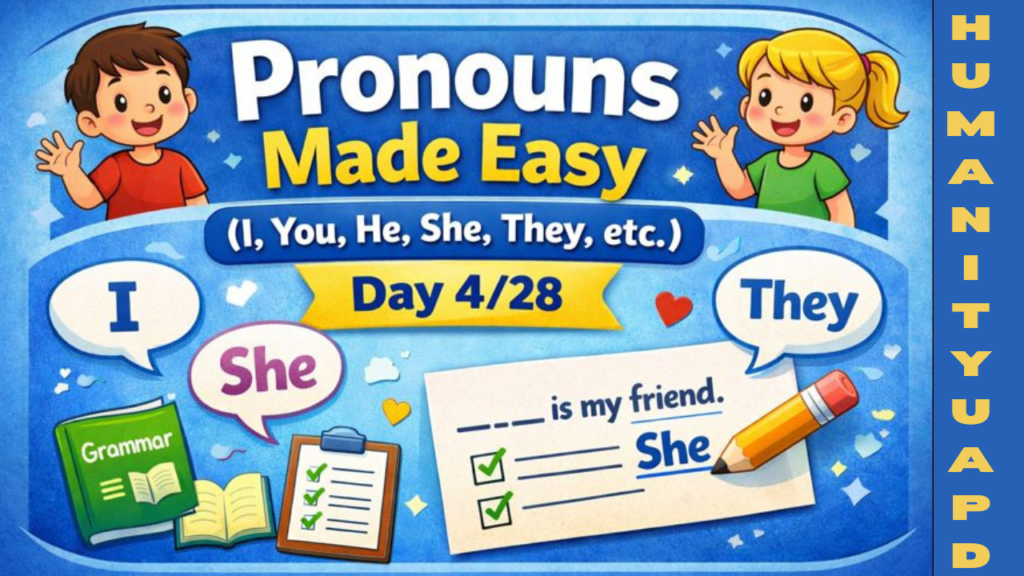
Pronouns Made Easy
Pronouns are integral components of language, serving as substitutes for nouns. They originate from the need to simplify and clarify speech and writing by replacing specific names or things. Without pronouns, communication would often become cumbersome and repetitive, as individuals would need to continuously restate nouns. For example, instead of saying, “Emily loves soccer, and Emily plays soccer on weekends,” one might say, “Emily loves soccer, and she plays it on weekends.” Here, “she” replaces the noun to streamline the sentence.
Pronouns can be divided into several categories, including personal, possessive, reflexive, relative, and demonstrative pronouns. Each type plays a unique role in enhancing communication. Personal pronouns, such as “I,” “you,” “he,” “she,” “it,” and “they,” refer to specific individuals or groups in conversation. They help clarify who is being spoken about without having to repeat the noun each time, contributing towards more natural discourse.
The importance of pronouns extends beyond mere convenience; they also foster inclusivity and respect in language. For instance, using a person’s preferred pronouns acknowledges their identity, which is particularly significant in contemporary discussions about gender. Understanding how to appropriately use pronouns is thus not only about grammatical accuracy but also about honoring individual choices and promoting effective, respectful communication.
In summary, grasping the function and types of pronouns is essential for anyone looking to improve their communication skills. Pronouns serve to eliminate redundancy, clarify meaning, and foster inclusivity, making them a fundamental element of both spoken and written language.
👉 Table of Contents 👇
Types of Pronouns
Pronouns are an essential part of speech that serve to replace nouns, allowing for smoother communication. They can be categorized into several types, most notably subject pronouns, object pronouns, and possessive pronouns. Understanding these categories is fundamental for effective language use.
Subject pronouns are used as the subject of a sentence or clause, performing the action of the verb. The most common subject pronouns are: I, you, he, she, it, we, and they. For example, in the sentence “She is reading a book,” “she” is the subject pronoun that indicates who is performing the action.
Object pronouns, on the other hand, receive the action in a sentence, functioning as the object of a verb or preposition. The primary object pronouns include: me, you, him, her, it, us, and them. For instance, in the sentence “The teacher called me,” the pronoun “me” serves as the object receiving the action of being called.
Possessive pronouns demonstrate ownership and are used to indicate that something belongs to someone. Examples of possessive pronouns are: mine, yours, his, hers, its, ours, and theirs. In practice, one might say, “That book is mine,” where “mine” indicates ownership of the book.
Additionally, it is worth mentioning reflexive pronouns, which are utilized when the subject and object of a sentence refer to the same entity. Reflexive pronouns include: myself, yourself, himself, herself, itself, ourselves, and themselves. For example, “She taught herself to play the piano” shows that the subject “she” is also the object of the action being taught.
Everyday Examples of Pronouns
Pronouns play a significant role in everyday communication by replacing nouns, thus simplifying our sentences. For instance, consider the sentence “Maria is reading a book.” To avoid repetition, we can easily substitute the noun with a pronoun, resulting in “She is reading a book.” This example illustrates how the pronoun “she” replaces the name Maria, enhancing the flow of conversation.
Moreover, pronouns can assist in creating clarity in discussions. If someone asks, “Did James call you?” the response can be structured as “Yes, he did.” Here, the pronoun “he” substitutes James, maintaining an uncluttered dialogue. Similarly, using the pronoun “you” allows for immediate address, facilitating direct interaction, as seen in phrases like “You should see this.”
Pronouns also aids in establishing connections between subjects. For example, in the sentence “Lucy and I are going shopping,” one might respond, “They invited us to join them.” In this case, “they” refers to the people who issued the invitation, effectively linking back to previous sentences while ensuring that the communication remains clear and engaging.
Furthermore, employing pronouns in storytelling enhances readers’ engagement. Instead of saying, “The dog chased the ball and the dog retrieved the ball,” a more fluent alternative would be, “The dog chased the ball, and it retrieved it.” This illustrates how the use of pronouns such as “it” can help maintain the rhythm of storytelling, making it more enjoyable for the audience.
By integrating pronouns seamlessly into our daily conversations, we can foster more effective communication while achieving a smoother narrative flow in both speaking and writing.

Nouns vs. Pronouns
The distinction between nouns and pronouns is a fundamental aspect of English grammar that significantly impacts sentence structure and clarity. Nouns are words that identify people, places, things, or ideas; for example, in the sentence “Maria loves music,” both “Maria” and “music” are nouns. However, repeated usage of nouns can lead to redundancy, making sentences cumbersome. To illustrate this, consider the longer sentence: “Maria loves music. Maria plays music every day to improve Maria’s skills.” Here, the repeated noun “Maria” disrupts the flow and can lead to reader fatigue.
In contrast, pronouns serve as substitutes for nouns, allowing for more concise and fluid language. By replacing nouns with pronouns, such as “she” or “it,” we can simplify the previous example: “Maria loves music. She plays it every day to improve her skills.” In this case, the use of pronouns significantly enhances the sentence, making it less repetitive and more dynamic.
Pronouns not only facilitate smoother reading but also help in maintaining the flow of conversation or writing. For instance, in dialogues or narratives, frequent use of proper nouns can detract from engagement. By strategically employing pronouns, authors and speakers can create a natural tone that resonates more effectively with their audience. While nouns provide specific identification, employing pronouns appropriately allows for a balance between clarity and conciseness.
Ultimately, understanding when and how to replace nouns with pronouns is a key component of effective communication, leading to improved readability and engagement in both written and spoken language.
Conversation Examples
Understanding the practical application of pronouns in everyday dialogues can significantly enhance one’s language skills. Below are several short exchanges that showcase the usage of different pronouns such as I, you, he, she, and they in fluent conversations.
Example 1:
Alice: Have you seen James today?
Bob: Yes, I saw him at the coffee shop earlier. He looked busy.
Example 2:
Sarah: What are you planning for the weekend?
Megan: I am considering going hiking. What about you?
Sarah: I might join you if the weather is nice!
Example 3:
Mark: Did you hear about the concert next Friday?
Emily: Yes, I am excited to go! They are my favorite band.
Mark: That’s great! Can you get tickets for us?
Example 4:
John: Is Laura coming to the party tonight?
Michael: She said she would be there. I think she is bringing her friend.
These examples demonstrate how pronouns are seamlessly integrated into conversations. They serve as crucial components that enhance clarity and efficiency when communicating. By practicing similar dialogues, learners can become more comfortable in employing pronouns correctly, facilitating better understanding in their speech.
Common Mistakes with Pronouns
Pronouns are an essential part of language, serving as substitutes for nouns and enabling clarity in communication. However, learners often encounter certain mistakes when using pronouns, which can lead to confusion or misunderstandings. Addressing these common errors is crucial for mastering their application.
One frequent mistake involves the misuse of subject and object pronouns. For instance, many learners mistakenly say, “Me and John went to the store,” instead of the correct form, “John and I went to the store.” This error occurs because the subject pronoun “I” should be used when the pronoun is part of the subject of the sentence. To prevent this mistake, a simple trick is to remove the other person’s name and see if the sentence still sounds correct. In this instance, “I went to the store” is grammatically accurate, while “Me went to the store” is not.
Another common pitfall is using the wrong possessive pronouns. Learners sometimes confuse “its” with “it’s.” While “it’s” is a contraction for “it is,” “its” indicates possession, as in “The dog wagged its tail.” To help remember this distinction, one can replace “it’s” with “it is” in the sentence; if it doesn’t make sense, then “its” is likely the correct choice.
Additionally, many speakers struggle with gender-neutral pronouns. The increasing acceptance of “they” as a singular pronoun can be confusing. A common mistake is to incorrectly use “he” or “she” when referring to an individual whose gender is unknown or irrelevant. Using “they” can promote inclusivity, as in the sentence, “Everyone should bring their own lunch; they won’t be provided.” This reflects a growing cultural shift towards recognizing diverse identities.
By identifying and correcting these common pronoun mistakes, learners can significantly improve their grammatical proficiency and enhance their communication skills.
Practice Exercises
Engaging in practical exercises is an essential way to solidify your understanding of pronouns. Here, we have devised several fill-in-the-blank exercises aimed at helping learners replace nouns with appropriate pronouns. This will enhance familiarity with pronoun usage in various contexts.
1. Maria is my best friend. __________ loves to read mystery novels.
(Answer: She)
2. The dogs barked all night. __________ were very loud.
(Answer: They)
3. John and I are going to the park. Would you like to join __________?
(Answer: us)
4. The teacher gave his students a homework assignment. __________ must complete it by Friday.
(Answer: They)
5. Lisa is an excellent musician. __________ plays the piano beautifully.
(Answer: She)
6. The book belongs to Tom. Please return __________ to him.
(Answer: it)
7. My parents are visiting this weekend. __________ are excited to see us.
(Answer: They)
8. I saw James at the store yesterday. Have you talked to __________ lately?
(Answer: him)
9. Those cookies are delightful! You should try __________.
(Answer: them)
10. The weather today is beautiful. I hope __________ stays nice for the weekend.
(Answer: it)
These exercises aim to provide hands-on opportunities to practice identifying and using pronouns accurately. By replacing nouns with suitable pronouns, learners can develop better sentence fluency and clarity in their writing. As you work through these examples, consider how pronouns streamline communication and make sentences more efficient. Practicing these fill-in-the-blank exercises will surely contribute to mastering the use of pronouns in everyday language.

Quick Tips for Pronoun Usage
Understanding pronouns is essential for effective communication. The following tips provide straightforward guidelines for using different types of pronouns in daily conversation.
First, subject pronouns such as “I,” “you,” “he,” “she,” and “they” are used as the subject of a sentence. Remember, when you are stating who is performing the action, these are the pronouns to use. For example, “I am going to the store” emphasizes the speaker’s action.
On the other hand, object pronouns including “me,” “you,” “him,” “her,” “us,” and “them” function as the object of a verb or preposition. They are essential when you want to denote whom an action is directed toward. An example is, “She gave the book to me,” which identifies the recipient of the action.
Possessive pronouns like “my,” “your,” “his,” “her,” “its,” “our,” and “their” indicate ownership. A rule of thumb is to use them to attribute ownership or relation. For instance, “This is my car” clearly shows possession and removes the ambiguity regarding ownership.
Another important aspect is the use of reflexive pronouns, such as “myself,” “yourself,” “himself,” “herself,” “ourselves,” and “themselves.” These pronouns are used when the subject and object of the verb refer to the same entity. An example could be, “He made the cake by himself,” illustrating independence in the action.
Finally, with the increasing emphasis on inclusivity, it is vital to be mindful of using “they” as a singular pronoun to refer to individuals whose gender is unknown or when discussing non-binary identities. This approach fosters respect and acknowledges diverse gender identities.
Conclusion and Encouragement
As we conclude our exploration of pronouns, it is essential to reiterate their significance in effective communication. Pronouns such as I, you, he, she, and they serve as fundamental building blocks in the English language. By mastering their use, learners can enhance their speaking and writing clarity, ensuring that they convey their thoughts and ideas with precision.
Throughout this discussion, we have highlighted the various types of pronouns and their appropriate contexts. I hope you found the explanations valuable and accessible. Understanding how to integrate pronouns into your conversations and writing can significantly improve your language skills. Each pronoun serves a purpose, allowing us to express ourselves in a nuanced manner.
To ensure that this knowledge translates into confident use, it is encouraged that learners practice employing these pronouns in their everyday conversations. Whether chatting with friends or writing notes, actively using pronouns will help solidify your understanding and familiarity with them. You might consider keeping a journal or engaging in language exchange sessions where you can concentrate on incorporating pronouns into your dialogue.
Remember, language acquisition is a gradual process that necessitates regular practice and patience. The more you engage with pronouns in various contexts, the more intuitive their usage will become. Embrace the journey of learning, and do not hesitate to experiment with different pronouns as you communicate. With dedication and practice, your proficiency will flourish.
In summary, the mastery of pronouns opens doors to engaging in more complex and fulfilling conversations. Approach your learning with enthusiasm, and soon you will find yourself utilizing pronouns fluently and effectively in your daily interactions.
FAQs: Pronouns Made Easy
What are pronouns and why are they important?
Pronouns are words that replace nouns in a sentence, helping to avoid repetition and enhance clarity. They are essential in communication as they allow speakers and writers to refer to people or things without constantly naming them. This facilitates smoother flows in conversation and written texts, making them easier to understand.
How many types of pronouns are there?
There are several types of pronouns, each serving a specific purpose. The main categories include personal pronouns (I, you, he, she, it, we, they), possessive pronouns (my, your, his, her, its, our, their), reflexive pronouns (myself, yourself, himself, etc.), relative pronouns (who, whom, whose, which, that), and demonstrative pronouns (this, that, these, those). Each type plays a crucial role in constructing sentences and conveying different meanings.
How do I determine which pronoun to use?
Choosing the correct pronoun depends on the subject of the sentence. For example, use “I” when referring to yourself, “you” when addressing someone, and “he” or “she” when talking about another person. In plural forms, opt for “we” for yourself and others combined, and “they” for groups or individuals unspecified in gender. Understanding the context of your sentence and the role of the subject will aid in proper pronoun selection.
Can pronouns change based on gender?
Yes, many pronouns indicate gender, specifically the third-person singular pronouns: “he” (masculine) and “she” (feminine). Additionally, the use of “they” as a singular pronoun is increasingly accepted in English to represent individuals who identify outside the traditional gender binary. It is important to respect the preferred pronouns of individuals, as they reflect personal identity.
What common mistakes should I avoid with pronouns?
Common errors include mismatching pronouns with their antecedents in gender and number, using subjective pronouns in objective cases, and neglecting to use pronouns that match the referent’s identity. Proofreading your writing helps catch these mistakes, enhancing clarity and ensuring respectful use of pronouns.

Share this:

