
Using Pronouns in Daily Sentences: Easy Guide for You (2026)

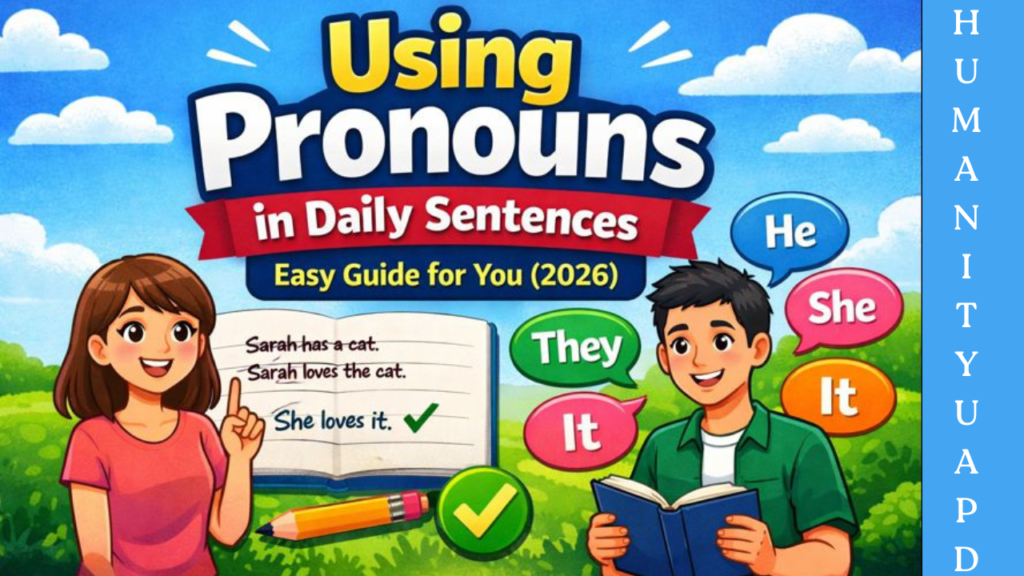
Using Pronouns in Daily Sentences
Pronouns are an essential part of speech in the English language, functioning as substitutes for nouns to enhance the efficiency and fluidity of communication. By replacing specific nouns, pronouns allow speakers and writers to avoid repetition, thereby streamlining sentences and making dialogue smoother. Instead of saying “Sarah played with Sarah’s dog in the park,” one can simply state, “She played with her dog in the park.” This utilization of pronouns contributes to clearer and more concise language.
In everyday conversation, the importance of pronouns cannot be overstated. They serve not only as linguistic tools but also as indicators of relationships and contexts. For instance, using the correct pronouns can reflect the speaker’s familiarity with the subject matter or their emotional connection to it. Moreover, pronouns help to create a sense of belonging and inclusion, particularly in diverse social landscapes where gender identity and expression are valued.
The efficiency gained from using pronouns also promotes engagement in communication. When listeners can quickly grasp who or what is being referred to, it allows for fluid exchanges that minimize misunderstandings. This capability is particularly beneficial in complex discussions where multiple subjects may be present. In such scenarios, pronouns act as anchors, guiding the audience through the conversation without losing track of the main points being discussed.
To summarize, pronouns play a vital role in both spoken and written communication, allowing for efficiency, clarity, and connection. Their proper use not only enhances sentence structure but also improves overall conversational dynamics, making them indispensable in effective communication.
👉 Table of Contents 👇
What Are Pronouns?
Pronouns are essential components of language that function as substitutes for nouns. They help to enhance clarity and reduce repetition within sentences, making communication smoother and more efficient. Rather than repeating a noun multiple times, which can make speech or writing cumbersome, pronouns allow us to refer back to that noun with ease.
For instance, consider the sentence: “Maria loves her dog. Maria takes her dog for walks every day.” In this example, the noun “Maria” is repeated, which can be redundant. However, by using pronouns, we can modify the sentence to: “Maria loves her dog. She takes it for walks every day.” Here, the pronouns “she” and “it” stand in for the nouns, making the sentence more concise and fluid.
Pronouns can be categorized into several types, including personal pronouns (e.g., I, you, he, she, it, we, they), possessive pronouns (e.g., my, your, his, her, its, our, their), demonstrative pronouns (e.g., this, that, these, those), and more. Each type of pronoun serves a distinct function. For example, personal pronouns are typically used to indicate a specific person or thing, while possessive pronouns express ownership.
In addition to simplifying sentences, pronouns also prevent redundancy, allowing writers and speakers to maintain variety in their language use. This variety can enhance the listener or reader’s engagement with the content. Understanding pronouns is crucial for effective communication, especially for those learning the intricacies of a language. By grasping the role of pronouns, one can easily convey thoughts and ideas clearly and succinctly in everyday language.
How Pronouns Replace Nouns
In daily communication, the use of pronouns serves as a crucial linguistic tool that enhances the fluidity and clarity of our speech. For instance, consider the following sentence that relies on repeated nouns: “Maria went to Maria’s favorite coffee shop because Maria wanted to try the new blend.” In this example, the repetition of the noun “Maria” could be perceived as redundant, hindering the natural flow of the sentence.
By incorporating pronouns, the sentence can be streamlined for improved readability: “Maria went to her favorite coffee shop because she wanted to try the new blend.” Here, the pronouns “her” and “she” effectively replace the repeated noun, creating a smoother and more cohesive expression. The use of pronouns allows the listener or reader to follow the narrative more easily while maintaining the reference to the subject.
Another example can be derived from a conversation about John’s activities. Initially, one might say, “John enjoys playing tennis. John also loves watching tennis matches on television. John practices every weekend to improve his skills.” In this case, the repetition of ‘John’ makes the sentence longer than necessary. By substituting pronouns, the sentences can be revised to, “John enjoys playing tennis. He also loves watching tennis matches on television. He practices every weekend to improve his skills.” This not only reduces redundancy but also adds a layer of engagement for the audience.
The effect of pronouns, therefore, is significant in everyday language use. They provide clarity by removing unnecessary repetition and allowing for more dynamic communication. By observing how pronouns can replace nouns, one can appreciate their role in creating succinct and effective language.

Common Pronouns Used Daily
Pronouns play a crucial role in everyday communication, simplifying sentences and avoiding repetition. The most frequently utilized pronouns can be categorized into subject pronouns and object pronouns.
Subject pronouns include I, you, he, she, it, we, and they. These pronouns perform the action of the verb in a sentence. For instance, “I am going to the store.” In this example, “I” is the subject performing the action of going. Similarly, “She loves to read,” and “They are watching a movie” illustrate the various subject pronouns in use. The pronoun it is often used for objects or situations, as in “It is raining outside.”
Object pronouns, on the other hand, include me, him, her, us, and them. These pronouns receive the action of the verb. For instance, “Can you help me?” Here, “me” is the recipient of the help. Another example is, “We saw them at the park,” where “them” refers to the people observed. Additionally, one might say, “I called her yesterday,” indicating that “her” is the object receiving the call.
Understanding these pronouns is essential for effective communication. They contribute to the fluency of speech and writing by enabling individuals to express themselves clearly and concisely. As these pronouns are commonly used in both spoken and written English, recognizing their forms and functions enhances one’s language skills in daily interactions.
Real-Life Daily Sentence Examples
Pronouns are integral in everyday communication, allowing for smooth and efficient exchanges. In conversations, personal pronouns often keep dialogues flowing. For example, during a friendly chat, one might say, “I enjoyed the movie; it was fantastic!” Here, the pronoun “I” refers to the speaker, while “it” refers to the movie, effectively reducing repetition.
In a school setting, teachers and students rely heavily on pronouns to clarify discussions. A teacher might say, “If anyone has questions, please raise your hand,” indicating students with the pronoun “your.” This use of pronouns encourages participation and ensures clarity in communication.
Workplace interactions are another area where pronouns significantly enhance clarity. A manager may communicate by stating, “I expect everyone to submit their reports by Friday,” where “I” denotes the manager, and “everyone” emphasizes all team members. Such constructions streamline directives and foster accountability.
At home, family conversations frequently incorporate pronouns. For instance, a parent might tell their children, “You need to finish your homework before dinner.” Here, the pronoun “you” directly addresses the children, making the message personalized and impactful.
In summary, the versatility of pronouns in various contexts—whether casual chats, educational environments, professional settings, or family discussions—ensures that communication flows seamlessly. By effectively replacing nouns, pronouns contribute to more engaging and concise interactions in daily life, demonstrating their fundamental role in the fabric of language.
Short Daily Conversation Examples
In everyday conversations, pronouns play a crucial role in enhancing clarity and fluency. Below are some mini dialogues that demonstrate the seamless integration of pronouns.
Dialogue 1:
Person A: “Did you see the new movie last weekend?”
Person B: “Yes, I did! I thought it was fantastic. What about you?”
Person A: “I haven’t watched it yet, but I heard it was great. I’ll definitely go see it this week.”
Dialogue 2:
Person A: “Where did Sarah go?”
Person B: “She went to grab lunch with her friends. I think they wanted to try that new café nearby.”
Person A: “Oh, I heard it was really good! I hope they enjoy it.”
Dialogue 3:
Person A: “Can you help me with this?”
Person B: “Of course! Just show me where you are stuck. I will help you figure it out.”
Person A: “Thanks! I really appreciate it. You always know how to make things easier for me.”
Dialogue 4:
Person A: “I heard you got a promotion at work. Congratulations!”
Person B: “Thank you! I’m excited about the new responsibilities. It has been a lot of hard work, but it finally paid off.”
Dialogue 5:
Person A: “What are you doing this weekend?”
Person B: “I’m planning to visit my parents. They’ve invited me over for dinner. How about you?”
Person A: “I will probably just relax at home. I need a weekend to recharge before the busy week ahead.”
These dialogues illustrate how pronouns, such as ‘I’, ‘you’, ‘he’, ‘she’, and ‘they’, are used to refer to people and things efficiently, making conversations more fluid and relatable. Using pronouns not only avoids repetition but also fosters a more natural spoken interaction, proving essential in enhancing everyday communication.
Tips for Using Pronouns Correctly
Effective pronoun usage is essential for clear communication in both spoken and written language. Here are some practical tips that learners can apply to improve their understanding and application of pronouns.
First and foremost, it is crucial to avoid ambiguity in pronoun references. Ambiguity can stem from having multiple possible antecedents. To prevent this confusion, always ensure that the pronoun clearly refers to one specific noun. For instance, instead of saying “When Sarah spoke to Jessica, she felt happy,” specify who is feeling happy: “When Sarah spoke to Jessica, Sarah felt happy.” This straightforward approach clarifies the reference.
Another key aspect of using pronouns correctly is matching them with their antecedents in terms of number and gender. This means that if the antecedent is singular, the pronoun should also be singular, and if it is plural, the pronoun must likewise be plural. For example, for the antecedent “the dog” (singular), use “it”; for “the dogs” (plural), use “they”. Such consistency is vital for maintaining the integrity of the statement.
Additionally, ensuring subject-verb agreement is vital when employing pronouns. Pronouns serving as subjects must align with the verb in both number and person. For example, in the sentence “He goes to the store,” the singular male pronoun “he” correlates with the singular verb “goes.” Conversely, in “They go to the store,” the plural pronoun “they” is paired with the plural verb “go.” This grammatical alignment sustains clarity and coherence.
By adopting these strategies, learners can enhance their pronoun usage, helping to convey their messages more effectively in everyday conversations.
Common Mistakes and Corrections
Understanding the correct usage of pronouns is essential for clear communication. However, learners often make common mistakes that can lead to confusion. One frequent error is mixing up subject and object pronouns. Subject pronouns, such as “I,” “he,” “she,” and “they,” are utilized when the pronoun is performing the action of the verb. In contrast, object pronouns like “me,” “him,” “her,” and “them” are used when the pronoun receives the action.
For instance, consider the incorrect sentence: “Me and Sarah went to the store.” The correct way to phrase this would be: “Sarah and I went to the store.” Here, “I” is the subject pronoun that correctly indicates who performed the action of going.
Another common mistake is in the incorrect use of reflexive pronouns. Learners may erroneously say: “He gave it to myself,” instead of the proper form, which is: “He gave it to me.” The reflection on oneself should only be applied in contexts such as: “I made myself a sandwich,” where the subject and object are the same person.
Possessive pronouns can also create confusion. For example, one might mistakenly say, “This is mine book” instead of the correct form: “This is my book.” In this case, “my” is the possessive adjective that modifies the noun “book.” Such distinctions are crucial for grammatical accuracy.
By recognizing these common errors and understanding their corrections, learners can enhance their command of the English language. Increasing awareness of the different types of pronouns and their appropriate contexts will lead to improved writing and speaking skills.

Practice Exercise
To reinforce your understanding of pronouns, here is a practical exercise designed to help you replace nouns with the appropriate pronouns. Below are a series of sentences where specific nouns are underlined. Your task is to rewrite each sentence by replacing the underlined nouns with suitable pronouns. This will not only enhance your comprehension but also improve your daily usage of pronouns in regular conversation.
1. Maria loves to read books. *Ask yourself: Who loves to read?*
Rewrite: __________ loves to read books.
Pronoun options: She, He, They
2. The weather is beautiful today. *Consider: What is beautiful?*
Rewrite: __________ is beautiful today.
Pronoun options: It, They
3. John and Sarah went to the market. *Reflect on: Who went to the market?*
Rewrite: __________ went to the market.
Pronoun options: They, He, She
4. The dog is barking loudly. *Think about: Which animal is barking?*
Rewrite: __________ is barking loudly.
Pronoun options: It, They
5. The children are playing in the park. *Note: Who is playing?*
Rewrite: __________ are playing in the park.
Pronoun options: They, It
By practicing these exercises, you will gain confidence in identifying and using pronouns effectively in your sentences. Take your time to think of the correct pronouns for each sentence and consider the context. This exercise is meant to facilitate your understanding of when and how to use pronouns properly.
Conclusion
Incorporating pronouns into daily communication is essential for fostering clarity and coherence in both spoken and written language. Pronouns serve as linguistic tools that replace nouns, reducing repetition and allowing for fluid discourse. Given their significant role in effective communication, it is vital for individuals to become adept at using various types of pronouns, including personal, possessive, relative, and demonstrative pronouns. By doing so, one can enhance the overall quality and readability of their conversations and written texts.
To master the usage of pronouns, active practice is key. Individuals are encouraged to consciously incorporate pronouns in everyday interactions, whether in casual discussions or formal presentations. This practice not only aids in reinforcing one’s understanding of grammatical structure but also contributes to improved clarity. Rather than being mere filler words, pronouns can carry substantial meaning and context within sentences.
As one continues to engage with pronouns, it becomes increasingly apparent how they can streamline communication. Their effective use allows speakers and writers to maintain engagement with their audience while ensuring that the message is communicated clearly. Furthermore, being proficient in pronoun usage can also contribute to a more personalized tone in conversations, fostering better connections with others.
Thus, it stands to reason that the consistent application of pronouns in daily speaking and writing is not only beneficial but integral to effective communication. By making an effort to practice this aspect of language, individuals will undoubtedly experience enhanced clarity and expressiveness in their communications.
FAQs: Using Pronouns in Daily Sentences
Pronouns are integral components of the English language, designed to replace nouns and refer to individuals or entities within a sentence. Their primary purpose is to avoid repetition and facilitate smoother communication. Below are some common questions that beginners may have regarding pronouns.
What are pronouns?
Pronouns are words that substitute for nouns, allowing speakers and writers to express themselves more naturally. Common examples include words such as “he,” “she,” “it,” “they,” and “we.” These words can represent people, objects, and ideas, depending on context.
Why are pronouns important in sentences?
The use of pronouns is crucial for coherence in language. By employing pronouns, speakers can refer back to previously mentioned nouns without needing to repeat them. This aids in creating more fluid and concise sentences, making communication clearer.
How can I practice using pronouns in daily conversation?
To enhance your understanding and usage of pronouns, consider incorporating them into your daily interactions. Start by identifying nouns in your conversations and replacing them with the appropriate pronouns. For example, if you say “Maria has a book,” you can replace “Maria” with “she” in subsequent sentences. Additionally, engage in exercises such as writing short paragraphs where you consciously use different types of pronouns.
What are some tips for beginners?
One effective tip is to pay attention to how native speakers use pronouns in various contexts. Listening to conversations, watching television shows, or reading books can provide insights into the natural flow of pronoun use. Moreover, practicing speaking and writing with different pronouns will enhance your comfort level and proficiency.
By familiarizing yourself with pronouns and their applications, you can improve your language skills and enhance your overall communication abilities. Understanding and practicing pronouns will ultimately lead to more effective and confident usage in both spoken and written English.

Share this:

