
Week 2 Revision and Practice | Easy English Course (2026)

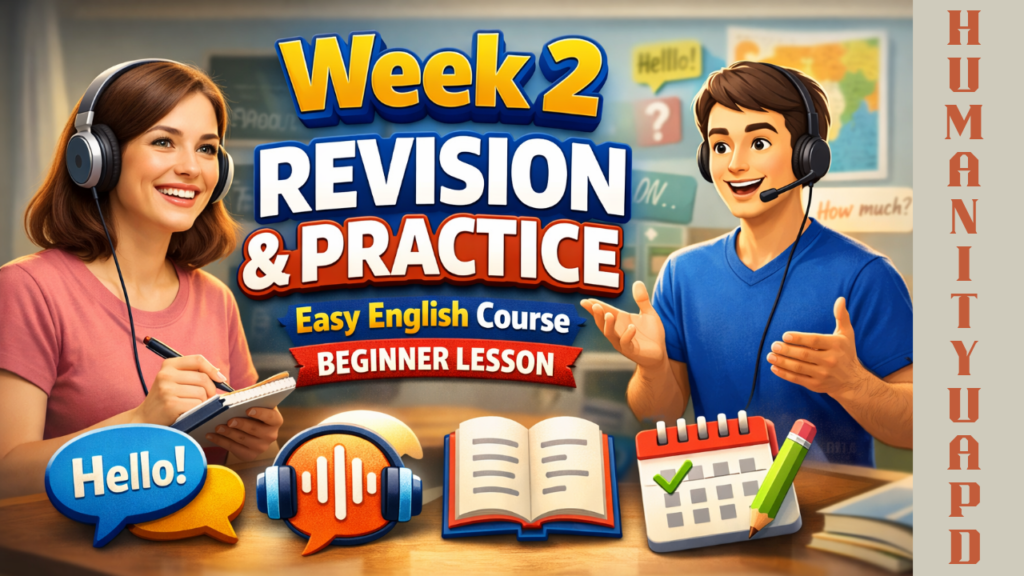
Week 2 Revision and Practice
Welcome to Week 2 of our Simple English for Beginners program. The primary purpose of this blog post is to provide a structured revision of the key concepts, vocabulary, and phrases that have been covered during the past week. As language learners, it is essential to reinforce what you have learned, and this week’s revision will guide you in doing just that.
Revision plays a crucial role in the learning process, especially when acquiring a new language. By revisiting previously learned materials, learners are more likely to strengthen their memory recall. It helps to solidify new words and phrases in your mind, making them easier to use in everyday conversations. This systematic review not only fosters retention but also builds confidence in your language skills.
This week, we will focus on the vocabulary and phrases introduced, ensuring that you can recognize and properly utilize them. Our revision will include exercises that provide a platform for practicing these terms. By engaging with the material actively, you will enhance your language acquisition skills, enabling you to use Simple English more effectively.
It is important to engage with the revision content at your own pace. To facilitate your learning, make notes of any difficulties you encounter and dedicate additional time to those areas. Remember, every effort you invest in revision will contribute to your overall mastery of the language. As we progress through this blog post, keep in mind the significance of consistency in practice and the power of revision in achieving fluency.
👉 Table of Contents 👇
Key Vocabulary Review
In week 2, several important words and phrases were introduced that are essential for beginners in Simple English. These vocabulary items are not only foundational but also widely applicable in everyday conversation. Below is a list of these words along with examples to enhance understanding and practical usage.
1. Hello: This is a common greeting used to acknowledge someone. For example: “Hello, how are you?”
2. Thank you: A polite expression used to show gratitude. For example: “Thank you for your help.”
3. Please: A courteous addition to requests, making them more polite. For example: “Could you pass the salt, please?”
4. Good morning: A greeting used in the morning, typically before noon. For example: “Good morning! Did you sleep well?”
5. Goodbye: A parting phrase used when one is leaving. For example: “Goodbye! See you tomorrow!”
6. Yes: An affirmative response or agreement. For example: “Yes, I would love to join you.”
No: A negative response indicating disagreement or refusal. For example: “No, I do not want to go.”
7. Please wait: A polite request asking someone to be patient momentarily. For example: “Please wait a moment while I check the information.”
As you review this vocabulary, practice saying each word and phrase out loud. Repeating these key terms will help solidify your understanding and improve pronunciation. Regular practice is vital for mastery in language learning.
Everyday Situations for Using Simple English
Understanding how to use acquired vocabulary in practical settings is vital for beginners learning English. Consider the scenario of shopping at a local market. While browsing the aisles, a learner can use phrases such as “How much is this?” or “Can I have this one, please?” to inquire about prices or to ask for specific items. This setting allows learners to practice their vocabulary related to food, clothing, and everyday necessities.
Another situation is dining out in a restaurant. Upon entering, a learner may greet the staff with a simple “Hello” and use expressions like “I would like to order…” or “Can I see the menu?” These phrases help in effectively communicating preferences and choices during the dining experience. Additionally, the vocabulary learned can extend to discussing drinks, appetizers, and desserts, enriching the learning experience.
Meeting new people is another key aspect of daily life where learners can apply their vocabulary. Simple self-introductions using phrases such as “My name is…” and “I am from…” allow learners to engage in conversations. Asking questions like “What do you like to do?” helps them to practice their speaking skills while getting to know others. Such interactions not only enhance their vocabulary usage but also boost confidence in speaking English.
In conclusion, incorporating vocabulary into daily life scenarios fosters practical use of language skills. Whether one is shopping, dining, or socializing, applying learned vocabulary in context provides a deeper understanding and encourages regular practice. This approach ensures that language learning remains relevant and engaging for beginners.

Creating Simple Sentences with Vocabulary
In this section, we will explore how to create simple sentences using the vocabulary introduced in week 2 of our English course. Simple sentences are foundational in learning any language because they help convey clear thoughts and ideas. A simple sentence typically consists of a subject, a verb, and sometimes an object, forming a complete thought.
For example, consider the vocabulary words: “dog,” “run,” and “park.” We can construct the simple sentence: “The dog runs in the park.” Here, “the dog” serves as the subject, “runs” is the verb, and “in the park” is a prepositional phrase that provides additional detail about where the action occurs.
Let’s break it down further:
- Subject: This is what or who the sentence is about. In our example, “the dog” is the subject, representing the animal performing the action.
- Verb: This is the action or state of being. “Runs” is the verb, indicating what the subject is doing.
- Object or Complement: While our example does not have a direct object, many sentences include it. For instance, we could say, “The dog chases the ball.” Here, “the ball” becomes the object of the verb.
By using vocabulary from week 2, learners are encouraged to create their own simple sentences. For instance, if we add the words “cat,” “jump,” and “table,” a possible sentence could be, “The cat jumps on the table.” This reinforces the structure of the sentence and the meaning of the new vocabulary.
Practice is essential. By constructing your own sentences, you will become more familiar with sentence structure and vocabulary usage. Aim to create a few sentences each day using the new words, as this will enhance your understanding and retention of English.
Listening Exercise
Listening activities are an essential component of learning a new language, including English. For beginners, it is crucial to immerse themselves in the sounds and rhythms of the language, which can be accomplished through simple listening exercises. A great way to practice listening is by engaging with beginner-friendly audio materials or videos that focus on common vocabulary and everyday situations.
One recommended activity is to listen to short stories or dialogues designed for English learners. Another excellent resource is the HUMANITYUAPD YouTube channel, which features videos tailored to beginners, covering various topics in a fun and engaging manner.
Additionally, utilizing podcasts can also greatly benefit learners. By listening to authentic English conversations at a slower pace, students can begin to pick up vocabulary and pronunciation that will serve them well as they progress in their studies.
Incorporating listening exercises into your daily routine not only enhances your understanding of simple English but also helps in building your listening skills. Practicing with diverse audio materials will support developing your language abilities and boost confidence in your speaking and comprehension skills. Consistency is key, so try to dedicate a few minutes each day to enjoy these listening exercises, and you will likely notice a marked improvement in no time.
Speaking Practice
Practicing speaking is a crucial aspect of learning a new language, particularly for beginners. Engaging in conversation helps to reinforce vocabulary, improve pronunciation, and increase confidence. One effective method for beginners to enhance their speaking skills is by finding a language partner. This can be someone who is fluent in English or another learner who wishes to practice. Regular conversations with a partner allow learners to apply what they have learned in a supportive environment, facilitating better understanding and retention of the language.
In addition, practicing speaking in front of a mirror can be a valuable exercise. This approach allows learners to focus on their mouth movements, facial expressions, and overall delivery. It can also help to alleviate anxiety associated with speaking in front of others. By visualizing oneself engaged in conversation, learners can refine their skills and build self-assurance.
To foster more engaging conversations during practice, here are a few conversation starters that learners can use:
- What is your favorite hobby and why? This question encourages the learner to discuss personal interests and provides an opportunity to use descriptive language.
- Describe your daily routine. What do you usually do in a day? This topic not only helps practice present tense but also allows the learner to share insights about their life.
- What is one place you would love to visit and why? This query prompts learners to express their thoughts and aspirations while expanding their vocabulary related to travel and culture.
By incorporating these practices into their study routine, beginners can significantly bolster their speaking abilities, paving the way for more extensive communication skills in English.
Understanding Questions
Questions are essential for communication as they help us gain information, clarify details, and engage with others. In English, there are various types of questions that learners may encounter or need to ask. Understanding these types can significantly enhance a beginner’s ability to converse effectively.
One of the simplest forms of questions is the yes/no question, which can be answered with a simple ‘yes’ or ‘no’. For instance, a learner might ask, “Are you happy?” This structure typically begins with a verb (are), followed by the subject (you) and the adjective (happy). This straightforward format makes it easy for beginners to practice.
Another important category is the information question, which begins with question words such as who, what, where, when, why, and how. An example is “What is your name?” This question seeks specific information, inviting the other person to provide a detail about themselves. Similarly, someone might ask, “Where do you live?” This not only shows interest in the other person but also encourages a response that can lead to further conversation.
Additionally, learners may encounter tag questions, which involve a statement followed by a question tag, like in “It’s a nice day, isn’t it?” These questions can be helpful in confirming information or engaging others in discussion. They allow the speaker to seek agreement or understanding from the listener.
In summary, understanding the types of questions in English – whether they are yes/no questions, information questions, or tag questions – establishes a foundation for effective communication. By practicing these structures, beginners can enhance their conversational skills and foster meaningful interactions.

Fun Activities for Learning
Learning English can be a delightful journey when infused with enjoyable activities that foster engagement and creativity. To help beginners reinforce their language skills, incorporating fun games, interactive flashcards, and creative writing exercises can lead to more effective learning outcomes.
Games are an excellent way to stimulate interest and promote interaction among learners. For instance, word bingo can be tailored to focus on vocabulary relevant to the beginner’s level. Each player receives a card filled with English words, while the caller reads out definitions or synonyms. As learners mark the corresponding words on their cards, they develop both listening and comprehension skills in a lighthearted environment.
Another engaging activity that enhances vocabulary is the use of flashcards. These cards can be created for various themes such as animals, food, or daily activities. To add an element of fun, a memory matching game can be introduced where learners work in pairs or small groups to match words with images. This encourages teamwork while boosting recall and recognition in a playful setting.
Writing small notes in English can also nurture creativity and expression. Encourage learners to write short stories or diary entries about their daily experiences. This practice not only enhances their writing skills but also allows them to use new vocabulary in context. Additionally, learners can share their writings with peers, providing an opportunity for collaborative feedback and further engagement.
Incorporating these activities into English language learning not only reinforces skills but also instills joy and satisfaction. By embracing a variety of methods, learners are more likely to stay motivated and appreciate their progress in mastering the English language.
Conclusion and Encouragement
As we conclude this guide on simple English for beginners, it is essential to highlight the significance of practice and consistency in mastering a new language. Learning simple English, like any other skill, requires dedication and the willingness to engage with the material regularly. It is through continuous practice that one can gain fluency, improve vocabulary, and build confidence in speaking and writing.
It is important to recognize that making mistakes is an integral part of the learning process. Every learner, regardless of their background or experience, faces challenges and errors on their journey to language proficiency. These missteps provide valuable feedback and opportunities for growth, enabling learners to identify areas that need improvement. Embracing mistakes as part of the learning curve can reduce the fear of failure, allowing individuals to progress more comfortably and effectively.
Moreover, everyone learns at their own pace; there is no one-size-fits-all approach when it comes to language acquisition. Some may grasp concepts quicker than others, while some may take more time to feel comfortable with simple English. It is crucial to be patient and to honor one’s own learning journey. Instead of comparing progress with others, focus on personal milestones and achievements.
In summary, by committing to regular practice, embracing all aspects of learning—including mistakes—and being patient with oneself, anyone can improve their simple English proficiency over time. Remember, language learning is a gradual process, and with determination and a positive mindset, you can reach your goals. Keep going, and celebrate each step you take towards mastery!
FAQs – Week 2 Revision and Practice
What is the purpose of Week 2 revision?
The purpose of Week 2 revision is to review important vocabulary, phrases, and basic sentence structures learned during the week. Revision helps improve memory, confidence, and real-life communication skills.
Why is revision important in learning English?
Revision strengthens understanding, improves recall of words, and helps learners use English more naturally in daily conversations. Regular revision makes learning faster and more effective.
How can beginners practice vocabulary from Week 2?
Beginners can practice by:
– Saying words aloud
– Making simple sentences
– Using vocabulary in daily situations like shopping or greeting people
– Writing short notes or diary entries
What are simple sentences in English?
A simple sentence usually has:
Subject + Verb + Object/Place
Example: The dog runs in the park.
Simple sentences help beginners express clear ideas easily.
How can I improve my listening skills in English?
You can improve listening by:
– Watching beginner English videos
– Listening to short stories or slow conversations
– Practicing daily for a few minutes
Consistency is the key to better listening.
What is the best way to practice speaking English?
Good speaking practice methods include:
– Talking with a language partner
– Speaking in front of a mirror
– Answering simple daily questions
– Repeating sentences from videos or audio
Regular speaking builds confidence quickly.
What types of questions should beginners learn first?
Beginners should learn:
– Yes/No questions – Are you happy?
– Wh-questions – What is your name?
– Tag questions – It’s nice, isn’t it?
These help in real conversations.
Are fun activities helpful for learning English?
Yes. Games, flashcards, and creative writing make learning enjoyable and improve memory, vocabulary, and confidence.
How much time should I spend on revision each day?
Even 10–20 minutes daily is helpful. Short, regular practice is more effective than long, irregular study sessions.
What should I do if I make mistakes while learning English?
Mistakes are a normal and important part of learning. They help you understand what to improve. Stay positive, keep practicing, and your English will improve step by step.

Share this:

