
What Are Adverbs? Easy English Day #9 (2026) – #28 Days

What Are Adverbs?
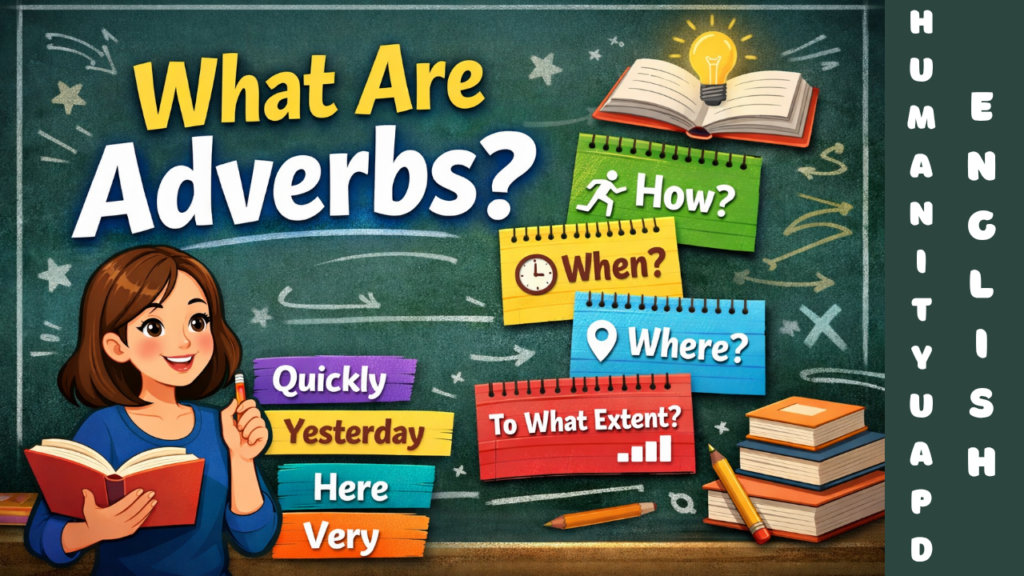
Adverbs are a crucial part of speech in the English language, serving the essential function of modifying verbs, adjectives, and even other adverbs. By definition, adverbs provide additional information about how, when, where, and to what extent an action is performed, adding depth and clarity to sentences. This modification can enhance the reader’s understanding of the action or description being conveyed.
Typically, adverbs can be identified by their ability to answer specific questions such as “how?”, “when?”, “where?”, and “to what extent?” For instance, if one considers the sentence “She ran quickly,” the adverb “quickly” modifies the verb “ran” by specifying the manner in which the running occurred. This enhancement illustrates the importance of adverbs as they significantly influence the meaning of the action being described.
Additionally, adverbs can also modify adjectives, which underscores their versatility. For example, in the phrase “very tall,” the adverb “very” modifies the adjective “tall,” indicating the degree of tallness described. Similarly, adverbs can modify other adverbs, as seen in the phrase “extremely quickly,” where “extremely” augments the meaning of the adverb “quickly.” This ability to modify multiple parts of speech is vital for articulating complex ideas and emotions succinctly.
In summary, adverbs play a significant role in grammar by determining the nuances of meaning in communication. Their capacity to modify various components within a sentence not only enriches the language but also allows for precise and vivid expression. Understanding how adverbs function is fundamental for mastering effective writing and comprehension in the English language.
👉 Table of Contents 👇
Types of Adverbs
Adverbs play a crucial role in enhancing the meaning of verbs, adjectives, and even other adverbs. They provide specific details about how, when, where, and to what extent actions take place. Understanding the various types of adverbs helps to clarify communication and effectively convey messages. The primary categories of adverbs include adverbs of manner, time, place, frequency, and degree.
Adverbs of manner describe how an action is performed. They often answer the question “how?” For example, in the sentence “She sings beautifully,” the adverb “beautifully” modifies the verb “sings,” indicating the manner of singing. Other examples include words like quickly, carefully, and gracefully, each providing insight into the specific way an action is executed.
Adverbs of time inform us when an action occurs, addressing the temporal aspect of a verb. Typical adverbs in this category include “now,” “yesterday,” and “soon.” In the phrase, “I will call you tomorrow,” the adverb “tomorrow” clearly indicates the time of the action.
Place adverbs answer the question “where?” They provide information on the location of an action. For instance, in the sentence “The book is here,” the adverb “here” tells us where the book is located. Similar examples can be seen with adverbs like “everywhere,” “upstairs,” and “abroad.”
Frequency adverbs express how often an action occurs, thus adding detail to the time aspect of verbs. Common examples include “always,” “sometimes,” and “never.” In “He always arrives early,” the word “always” denotes the regularity of the action.
Finally, adverbs of degree describe the intensity or extent of an action or another adverb. These include words like “very,” “quite,” and “too.” For example, in “She is very talented,” the adverb “very” modifies the adjective “talented” to highlight the extent of her talent.
In summary, recognizing the different types of adverbs—manner, time, place, frequency, and degree—enables us to use language more effectively and clearly convey our thoughts and observations.
The Importance of Adverbs in Writing
Adverbs play a crucial role in writing by enhancing the clarity and depth of expression. They serve as modifiers that add more detail to verbs, adjectives, and even other adverbs, thereby enriching the overall message conveyed by the writer. By providing context around the action, adverbs can emphasize how, when, where, and to what extent an event occurs, making the writing more dynamic and engaging.
In creative writing, the use of adverbs can evoke specific emotions, convey tone, and create vivid imagery. For instance, describing a character as ‘quickly running away’ paints a more urgent picture than simply stating they are ‘running away.’ Such nuances help readers visualize the scene more clearly and connect with characters on a deeper level. Consequently, the effectiveness of storytelling is often significantly enhanced through the deliberate implementation of adverbs.
In professional writing, where clarity and precision are essential, adverbs also serve as critical tools. They clarify statements, leaving little room for ambiguity. For example, stating that a proposal was ‘carefully reviewed’ indicates a thorough process, emphasizing the importance of diligence and consideration. In contrast, using a vague description could lead to misunderstandings about the level of analysis applied to the work.
Moreover, adverbs can influence the tone of a piece of writing. A formal report might use adverbs such as ‘methodically’ or ‘strategically’ to convey professionalism, while a personal narrative can incorporate more expressive adverbs like ‘joyfully’ or ‘painfully’ to invoke emotion. Therefore, understanding the function of adverbs enables writers to manipulate outcomes intentionally, affecting how their audience interprets and reacts to the text.

Common Misconceptions About Adverbs
Adverbs often find themselves at the center of debates regarding their necessity and effectiveness in writing. One prevalent misconception is that adverbs are intrinsically excessive or detrimental to good writing. Critics of adverb use argue that they often indicate a weakness in the choice of verbs or adjectives. This perspective suggests that instead of relying on adverbs to modify verbs, writers should pursue stronger verbs that convey the action more vividly. For example, instead of saying “ran quickly,” one might choose “sprinted.” Although the rationale for this belief can be understood, it is essential to recognize that adverbs serve a vital function in language by providing clarity and richness to sentences.
Another misconception involves the notion that adverbs should always be avoided or minimized. This stance is not entirely accurate; rather, the effective use of adverbs depends largely on the context. In some instances, adverbs can significantly enhance the meaning of a sentence and establish tone, thereby contributing to a more nuanced understanding of the narrative. For example, in the phrase “She spoke softly,” the adverb adds emotional depth and can alter the reader’s interpretation of the character’s demeanor. Thus, the issue is not the existence of adverbs but rather their strategic application within various examples of writing.
The argument that adverbs can, and should, be replaced with stronger verbs or adjectives deserves further examination. While stronger verbs can indeed eliminate the need for adverbs, this does not imply that adverbs are redundant. Each element of language has its place, and adverbs, when used judiciously, can enhance writing rather than detract from it. Misconceptions about adverbs often stem from a misunderstanding of their purpose, which ultimately diminishes the appreciation of their powerful role in modifying and enriching language.
Using adverbs effectively is crucial for enhancing clarity and precision in writing. Adverbs serve as modifiers for verbs, adjectives, or other adverbs, conveying specific details about how, when, where, or to what extent actions are performed. However, it is important to strike a balance between employing adverbs for clarity and avoiding redundancy that may dilute the impact of your writing.
One key strategy for using adverbs effectively is to consider whether the adverb adds meaningful information to the sentence. For instance, rather than stating that someone “ran quickly,” it may be more effective to describe their action using a more vivid verb, such as “sprinted”. In this case, the stronger verb eliminates the need for the adverb altogether. When you choose adverbs, opt for those that enhance the imagery or emotional weight of the sentence without being excessive.
Additionally, varying the placement of adverbs within your sentences can impact the overall tone and flow of your writing. While adverbs can often be placed at the beginning or end of a sentence, their position can subtly change the emphasis and meaning. For example, saying “Surprisingly, he finished the race” emphasizes the unexpected nature of the action, whereas “He finished the race surprisingly” may shift the focus slightly towards the manner of the finish.
To ensure that your use of adverbs is effective, it is also advisable to avoid over-reliance on adverbs to convey meaning. Instead, aim to create strong, direct statements that utilize well-chosen adverbs sparingly. By doing so, you enhance the impact of your writing and create a more engaging reading experience.
Adverbs vs. Adjectives: Understanding the Difference
Understanding the distinctions between adverbs and adjectives is essential for grasping the mechanics of language. Both serve crucial roles in sentence construction; however, their functions and the elements they modify significantly differ. Adverbs primarily modify verbs, adjectives, or other adverbs, providing context or additional detail about the action, quality, or intensity. For instance, in the sentence “She runs quickly,” the adverb “quickly” modifies the verb “runs,” depicting how she executes the action of running. Similarly, in the phrase “very tall,” the adverb “very” modifies the adjective “tall,” intensifying the description of height.
On the other hand, adjectives modify nouns, offering more information about a person, place, thing, or idea. In the example “the vibrant flower,” the adjective “vibrant” modifies the noun “flower,” enhancing the reader’s understanding of its appearance. Thus, while adjectives serve to describe and characterize nouns directly, adverbs provide nuance to the actions or qualities associated with verbs and adjectives.
The clear separation in function can sometimes lead to confusion, particularly in instances where both adverbs and adjectives appear in a sentence. For example, consider the phrase “The remarkably beautiful sunset.” Here, the adjective “beautiful” modifies the noun “sunset,” while the adverb “remarkably” modifies the adjective, emphasizing just how beautiful the sunset is. This interplay demonstrates the versatility of both parts of speech and their capacity to enrich communication.
Grasping the differences between adverbs and adjectives not only enhances one’s writing skills but also facilitates a deeper appreciation for the complexities of language. It allows for more precise expression and encourages effective writing that resonates with clarity and effectiveness.
Adverbial Phrases and Clauses
Adverbial phrases and clauses serve critical roles in language by modifying verbs, adjectives, or other adverbs, thereby enhancing the description and meaning of a sentence. An adverbial phrase is a group of words that collectively function as an adverb. For instance, in the sentence “She runs very quickly,” the phrase “very quickly” modifies the verb “runs” by providing additional information about the manner in which she runs.
In contrast, an adverbial clause is a dependent clause that also serves as an adverb within a sentence. It typically begins with a subordinating conjunction such as “although,” “because,” or “when.” For example, consider the sentence “He stayed home because it was raining.” Here, the clause “because it was raining” explains why he stayed home, thus functioning as a modifier to the main action.
The importance of these structures cannot be understated, as they provide essential context that contributes to the clarity and richness of communication. Adverbial phrases and clauses can convey time, place, condition, reason, or manner, allowing the speaker or writer to articulate their thoughts more precisely. For example, in the sentence “After the meeting, we will discuss the project,” the phrase “After the meeting” indicates the specific time frame for the discussion, enriching the understanding of the temporal context.
Overall, incorporating adverbial phrases and clauses into writing improves the flow and comprehensibility of sentences. By weaving these modifiers into discourse, the subtle nuances of intention and context emerge, ultimately enhancing the reader’s engagement and understanding. Hence, mastery of adverbial constructions is imperative for effective language use, as they powerfully impact the depth of written and spoken expression.
Practice Exercises for Identifying and Using Adverbs
Engaging with language through practice is vital for mastering the use of adverbs. This section provides exercises that will help you identify adverbs within sentences and apply them in your writing effectively. Each exercise is designed to enhance your understanding and application of adverbs in various contexts.
To begin, review the following sentences and identify the adverbs present. Underline or highlight each adverb as it appears:
- The students worked quietly during the test.
- The dog ran quickly to its owner.
- She sings beautifully at the concert.
- He left the meeting early.
Once you’ve identified the adverbs, consider rewriting the sentences to modify their meaning or tone by utilizing different adverbs.
For instance, in the sentence:
The dog ran quickly to its owner.
You might replace “quickly” with “hastily” to suggest a sense of urgency or with “gracefully” to emphasize style. Explore various options and note how the overall meaning shifts with different adverb choices.
Now, for a more interactive challenge, correct the following sentences by adding appropriate adverbs or modifying the existing ones:
- The team played in the game.
- She spoke during the presentation.
- He completed the assignment.
Finally, it is crucial to recognize that the placement of adverbs can affect sentence flow. Experiment with inserting adverbs at different points within the sentences and observe how this changes the sentence dynamics. These exercises will assist you in developing your skills in both identifying and strategically using adverbs in your writing.

Conclusion: The Transformative Role of Adverbs in Language
In our exploration of adverbs, we have uncovered their significant role in enhancing the clarity and expressiveness of language. Adverbs serve as powerful modifiers, providing essential context by describing how, when, where, and to what extent actions occur. Their ability to transform simple sentences into vivid narratives illustrates their importance in both written and spoken communication.
We have seen various forms of adverbs, including those of manner, time, place, and degree. Each type contributes uniquely to the nuance of expression, allowing writers to convey precise meanings and emotional undertones. For example, the difference between saying “She ran quickly” versus “She ran slowly” vividly alters the imagery we create in our minds. Such distinctions showcase how adverbs catalyze variance in tone and interpretation.
Furthermore, the strategic use of adverbs can significantly enhance writing style and engagement, making it memorable. Through intentional selection of adverbs, authors can evoke specific reactions from readers, guiding their understanding and engagement with the text. It is crucial to recognize that while adverbs are instrumental in setting the mood, they must be employed judiciously to avoid redundancy and maintain clarity.
In light of all these aspects, we encourage readers to pay meticulous attention to the role of adverbs in their writing. By thoughtfully incorporating these modifiers, writers can enrich their narratives and ensure effective communication. Understanding the transformative power of adverbs can thus be seen as a fundamental step toward mastering the art of language, ultimately allowing for more impactful and nuanced expression in every form of writing.
FAQs – What Are Adverbs
What is an adverb in simple words?
An adverb is a word that describes a verb, adjective, or another adverb. It tells how, when, where, or how much something happens.
How can I easily identify an adverb?
Many adverbs end in “-ly” (quickly, slowly, happily), but not all. You can identify an adverb by checking if it answers questions like how, when, where, or to what extent.
Can adverbs modify adjectives and other adverbs?
Yes.
Very tall → “very” modifies the adjective “tall.”
Extremely fast → “extremely” modifies the adverb “fast.”
What are the main types of adverbs?
The most common types are:
– Manner (quickly, softly)
– Time (now, yesterday)
– Place (here, everywhere)
– Frequency (always, often)
– Degree (very, too, quite)
Are adverbs always necessary in writing?
No. Strong verbs can sometimes replace adverbs (“sprinted” instead of “ran quickly”).However, carefully chosen adverbs improve clarity, tone, and emotion.
What is the difference between an adjective and an adverb?
– Adjectives describe nouns (a beautiful flower).
– Adverbs describe verbs, adjectives, or other adverbs (runs quickly, very beautiful).
What is an adverbial phrase or clause?
– Adverbial phrase: a group of words acting like an adverb (very quickly, in the morning).
– Adverbial clause: a dependent clause acting like an adverb (because it was raining, when she arrived).
How can I improve my use of adverbs in English?
Practice by:
– Reading English sentences daily
– Rewriting sentences with different adverbs
– Using adverbs only when they add clear meaning

Share this:

